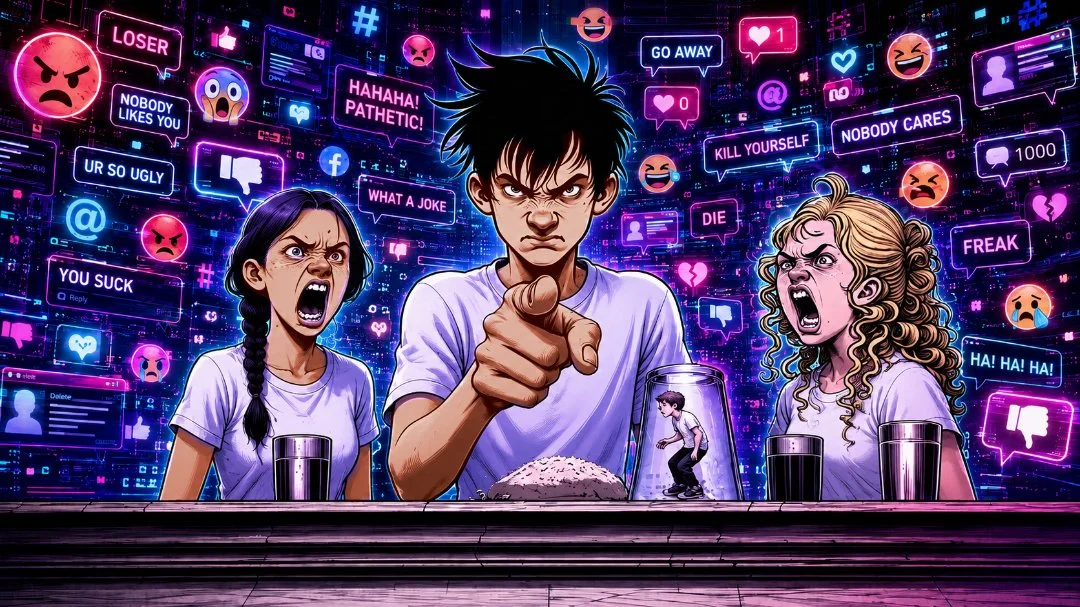
Simply telling young people, “Don’t harass others online,” is rarely enough. Advice alone does not compete with the complexity of the digital world they move through every day.
Cyberbullying is not an occasional issue. For many young teens, it is part of the environment they navigate. While the exact scale can be difficult to measure, due to differences in definitions and age groups surveyed (see* What Forms Can Cyberbullying Take?), the overall pattern is clear and consistent.
According to the Pew Research Center (2022), nearly half of all teens (46%) report experiencing at least one form of cyberbullying. More than a quarter (28%) have experienced multiple forms. What matters here is not only the size of these numbers, but their direction. The trend has been steadily rising over the past fifteen years.
Looking across a broader period, the Cyberbullying Research Center (2007–2021) found that, on average, 29% of middle and high school students had been targeted. At the same time, nearly 16% admitted they had cyberbullied others. This overlap is important. Many young people are not simply bystanders. At different moments, they may move between roles.
Cyberbullying also does not affect all young people equally. The Common Sense Media study Social Media, Social Life found that girls are more likely than boys to experience it. Other research shows increased vulnerability among young people with disabilities, those struggling with obesity, or those identifying as LGBTQ.
Even for those who are not directly targeted, cyberbullying is rarely invisible. Because it often unfolds in public digital spaces, many teens encounter it as witnesses. According to Common Sense Media, 23% of teens report trying to support someone who was being cyberbullied. This may involve reaching out privately, reporting the behaviour, or posting something positive to counter the harm.
Cyberbullying, then, is not just an individual experience. It is a shared digital reality that shapes how young people see others, and how they come to see themselves.
Experiencing Cyberbullying Through Story
This is where story becomes powerful.
Edufiction is not about telling young people what to think. It is about allowing them to experience, reflect, and understand through narrative.
The Mauled Mage – A Tale of Bravery Against Online Cruelty does not take a rules-based approach. Instead, it places readers inside the experience. Through the characters, they feel the weight of what cyberbullying does. The fear. The betrayal. The isolation. The quiet build-up of desperation.
But the story does something equally important. It also places the reader in the mindset of the cyberbully. Through anonymity, shifting identities, and the manipulation of others, readers see how harm can be justified, even rationalised, from the inside. What begins as a perceived slight can escalate into targeted cruelty.
Around this, the wider social world comes into focus. Friends, bystanders, and trusted adults each play a role. Support is shown not as a single action, but as a series of choices. Small interventions. Quiet courage. Restorative conversations that aim not only to repair harm, but to understand it.
In this way, the story moves beyond blame. It reveals that cyberbullying can sometimes emerge from a misplaced attempt to regain control or protect one’s own sense of safety.
By experiencing these dynamics safely through story, young readers begin to recognise them in real life. They are not just told what to do. They understand why it matters, and how their choices shape the digital spaces they are part of.