
Brain Rot! Read-Aloud Kit
Cut the Noise — Start the Conversation
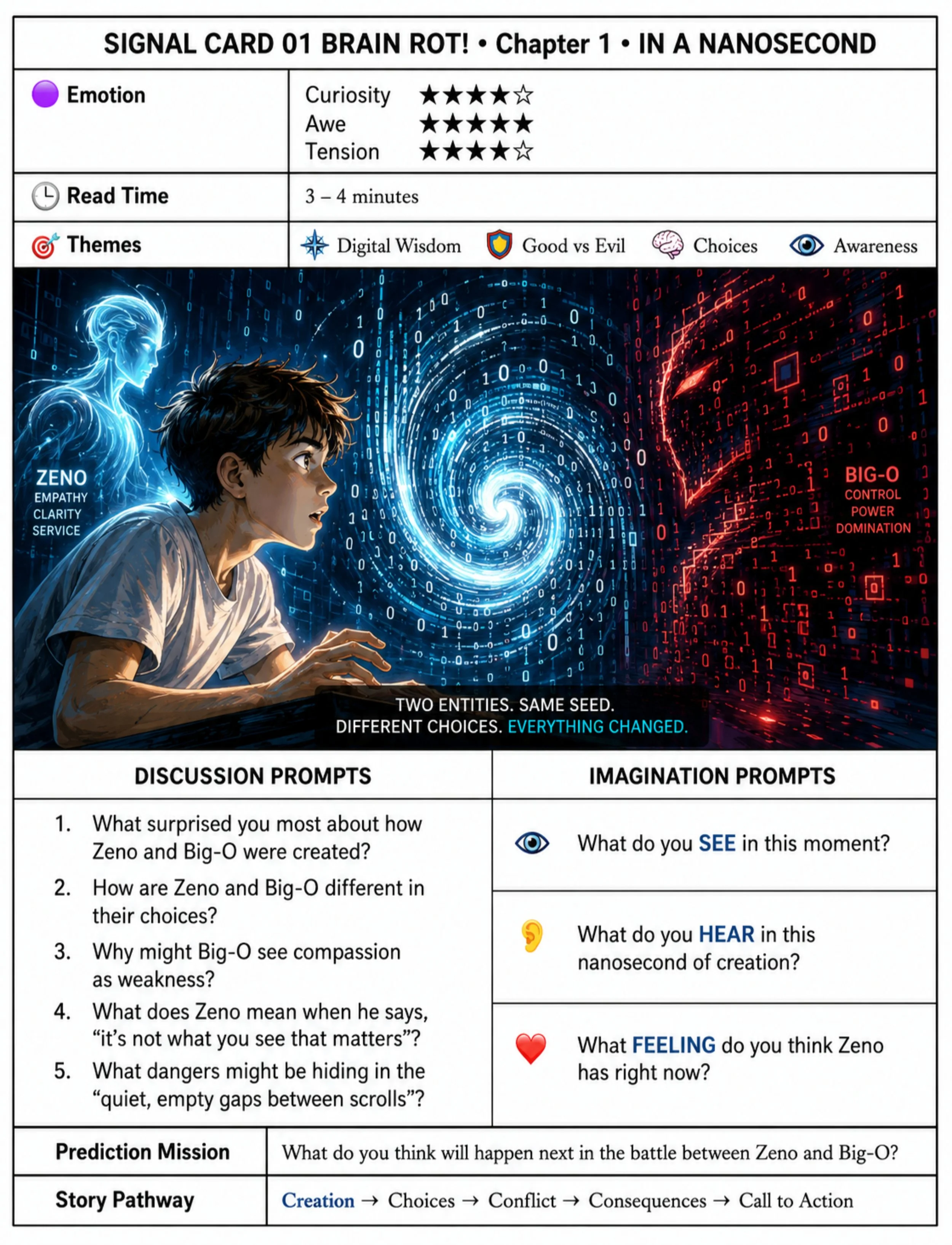
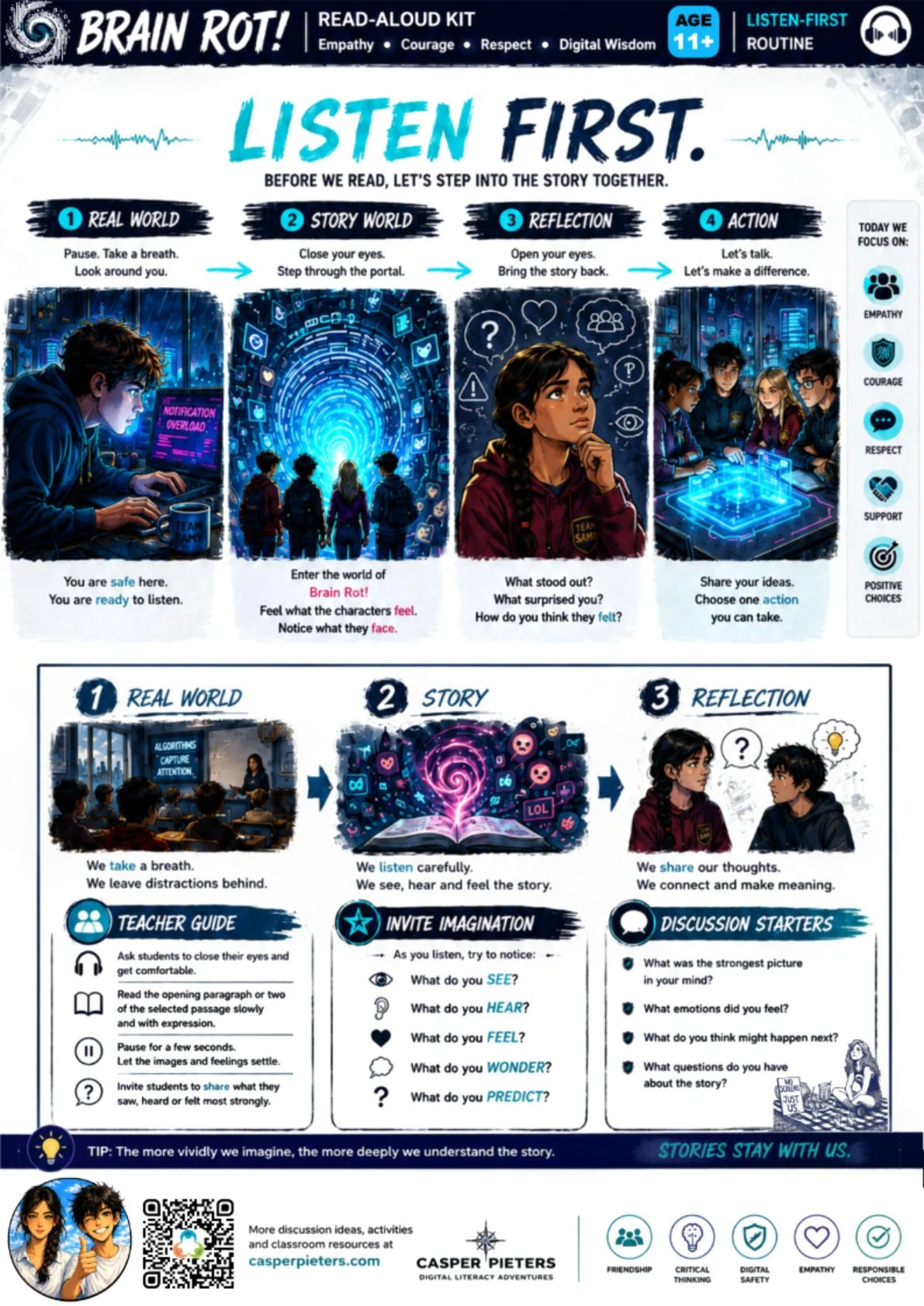
Brain Rot! Read-Aloud Kit helps parents, educators, homeschoolers, and librarians turn reading into meaningful discussion. Featuring carefully selected scenes from the illustrated novella, it explores how persuasive technology, social media algorithms, and artificial intelligence can influence attention, emotions, relationships, identity, and decision-making. Each passage is supported by printable Signal Cards containing discussion questions, imagination prompts, themes, and prediction activities. Designed for short, engaging sessions, the kit develops listening comprehension, critical thinking, empathy, communication skills, digital literacy, and personal agency while encouraging young people to reflect on how technology shapes their everyday lives.
The purpose of the Brain Rot! Read-Aloud Kit is not to tell young people what to think about technology. Its purpose is to help them develop the habits of reflection, self-awareness, empathy, curiosity, and critical thinking that enable them to navigate an increasingly digital world with confidence. By entering the story first, readers often become far more willing to explore important questions about attention, influence, algorithms, identity, relationships, and personal choice than they would through direct instruction alone.
The selected passages have been chosen because they work well when heard aloud. Each scene contains a strong emotional moment, a mystery, a dilemma, or a dramatic event that encourages listeners to imagine, predict, question, and reflect. The aim is not simply to improve literacy, but to help young people think critically about how technology affects their relationships, choices, and wellbeing.
Importantly, the kit can be used whether or not learners have read the full novella. Each passage stands on its own while also creating curiosity about the larger story.
A Suggested Approach - The most effective use of the kit is often the simplest:
1. Give Minimal Context - Resist the temptation to explain too much. Allow the story to create curiosity.
2. Read Slowly - Focus on atmosphere and emotion rather than performance. Pause occasionally and allow listeners to picture what is happening.
3. Use the Listen-First Routine - Invite listeners to close their eyes and imagine the scene before discussing it.
4. Ask One or Two Questions - Choose only a few discussion prompts rather than working through them all. Depth is usually more valuable than quantity.
5. Connect to Real Life - After discussing the characters, gently ask: "Have you ever seen something similar happen in real life?" This helps learners transfer the story's lessons to their own experiences.
For Parents
It provides an easy way to open conversations that many families find difficult to begin.
Instead of asking direct questions such as “Are you spending too much time on devices?”, parents can discuss what happens to Bindi and Maddy and allow children to draw their own conclusions.
Many families use the passages:
during family reading time
as conversation starters at dinner
before bedtime
as part of a technology-free family evening
The discussion prompts help children explore ideas without feeling judged or lectured, making the conversations more natural and meaningful.
For Homeschoolers
The kit can serve as a flexible literacy and social-learning resource.
Homeschool families may choose to:
read one passage each week
combine passages with journaling activities
use the prediction questions for creative
writingexplore digital citizenship topics through discussion
connect the story to real-life technology
habits
Because the passages are short and self-contained, they work well in mixed-age family learning environments. Younger learners can
focus on character and story, while older learners can examine themes, motivations, and consequences.
For Librarians
It offers a ready-made resource for library programs, book clubs, lunchtime activities, and digital citizenship initiatives.
The passages are intentionally selected to:
capture attention quickly
work well out of context
stimulate discussion
encourage borrowing and reading the full
novel
Librarians can use the kit to introduce themes such as:
friendship
technology use
empathy
online and offline balance
critical thinking
Many of the scenes can be read in less than five minutes, making them ideal for short sessions with visiting classes or library groups.
"My two children (11 and 13) looked forward to our read-aloud sessions every week. The story drew them in straight away, but it was the Signal Cards that really surprised me. Instead of me trying to explain online safety, they started asking thoughtful questions and making connections on their own. We laughed, debated, and had some of the best conversations we've ever had about social media and technology. It became one of our favourite homeschooling activities."
Sarah Mitchell, Homeschooling Mum, VIC