
How I Use AI
My Creativity Is Not for Outsourcing. My intuition leads. AI helps me explore. I decide what gets published.
I've spent much of my working life trying to make complicated subjects understandable. First as an ecologist, then through twenty years in science television, followed by educational technology, teaching and, more recently, writing adventure stories for young readers. Curiosity has always been the common thread. I tend to follow an interesting question wherever it leads, even when that takes me somewhere rather unexpected. These days, AI frequently comes along for the ride. I use it extensively. I might as well admit that upfront, because there's a growing tendency within the writing community to treat the words AI-assisted as though someone has confessed to a literary crime. I find that rather curious.
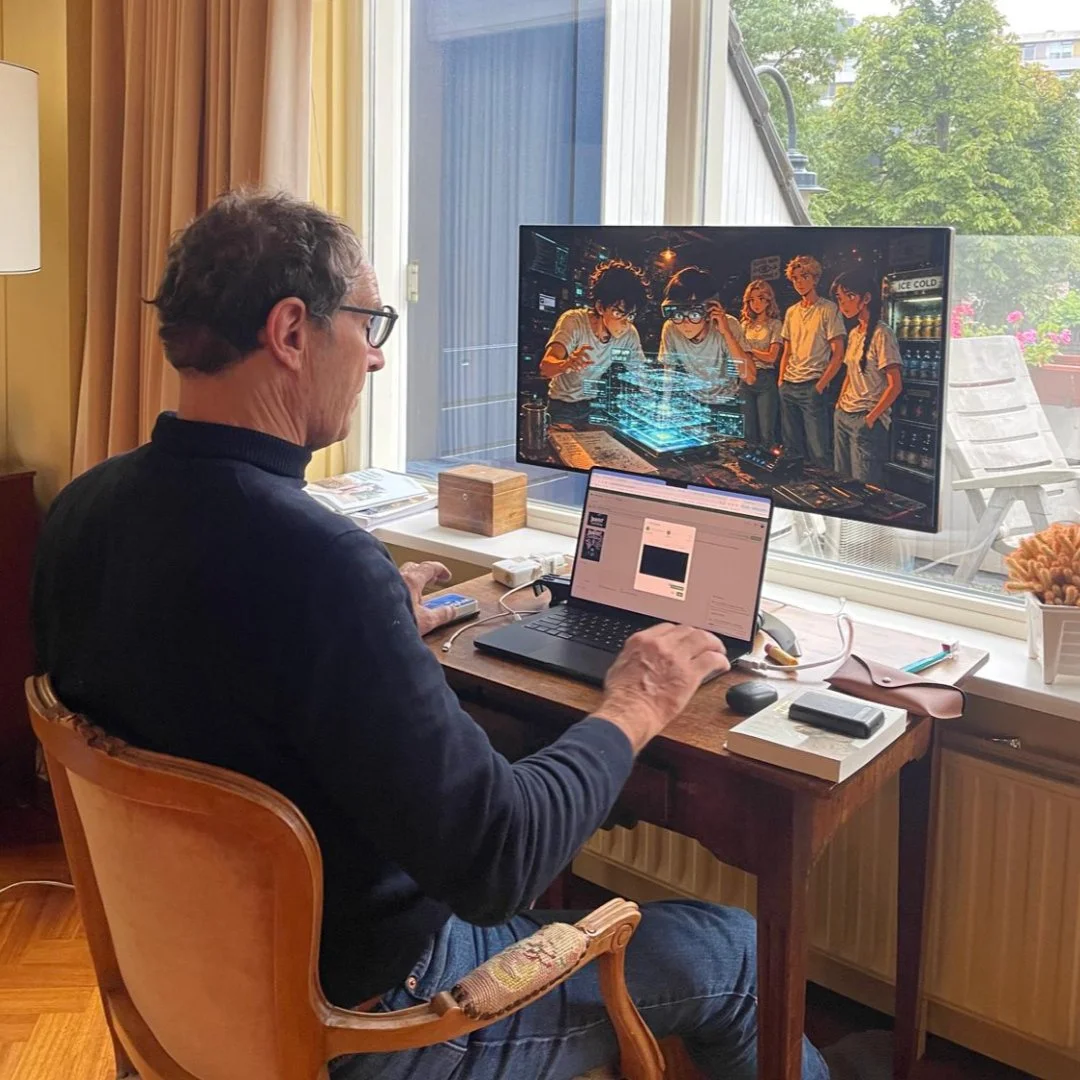
We have always used whatever tools were available to extend our abilities. Dictionaries, encyclopaedias, libraries, search engines, spelling checkers and the occasional long-suffering editor have all contributed to the books we read. AI adds some remarkable possibilities to that collection, although it also introduces problems we haven't yet figured out how to deal with. And some of those problems are serious. So, following the Alliance of Independent Authors' recommendation that writers explain their use of AI, here's how I work.
Where My Stories Begin
Usually with a question that won't leave me alone.
What happens when a young person becomes so absorbed in a virtual world that ordinary life begins to lose its appeal?
How can children recognise manipulation when the technology manipulating them is designed by people who understand human psychology exceptionally well?
What happens to our ability to think independently when a machine can deliver such convincing answers that we stop questioning them?
Questions like these eventually become stories.
In The Web Trap, Maddy's fascination with a virtual reality headset develops into something far more troubling. The Mauled Mage explores cyberbullying through a fantasy adventure, while Brain Rot! follows Beam as he discovers how easily persuasive technology can interfere with his attention and judgement. None of these stories began with AI suggesting a fashionable subject that might sell books. They grew out of my concerns about how young people experience technology, combined with my conviction that stories provide a particularly effective way to explore difficult subjects.
I develop the characters, their relationships, their motivations and the situations that force them to make choices. The educational questions emerge through their experiences. I want readers to become involved in what happens to these characters and, somewhere along the way, begin questioning what they might do in similar circumstances. That's the heart of my edufiction approach. AI becomes useful as those ideas develop.
An Interesting Companion to Have Around
One of the pleasures of writing is stumbling across a connection you weren't looking for. My background in ecology has probably made me particularly susceptible to this. Spend enough time studying natural systems and you begin to notice relationships everywhere. The behaviour of a social media algorithm, for example, can raise interesting questions about feedback loops, adaptation, competition and the way complex systems influence individual behaviour. AI is quite good at helping me investigate such connections.
I might begin by asking about a development in neuroscience, wander into behavioural psychology, explore a philosophical argument about consciousness and eventually find myself considering how a thirteen-year-old character might respond to an intelligent machine that appears to understand her better than her own family does. It's not always a particularly direct route to writing the next chapter. But that's often where the interesting material comes from. AI can help me explore unfamiliar territory, find relevant research, test an analogy or examine an idea from a perspective I hadn't considered. Sometimes I'll ask it to argue against a position I feel strongly about. Occasionally, it makes a convincing case. I rather like that.
If a tool only agrees with me, I'm not learning much. And AI has an unfortunate habit of being agreeable unless you encourage it to do otherwise. Of course, I also have to remember that its confidence is no guarantee of accuracy. I've encountered perfectly plausible explanations that fall apart as soon as you investigate the evidence. References need checking, scientific claims need examining, and an attractive analogy can be thoroughly misleading. That's where my scientific background comes in handy. I want to know where the information originated, whether the research supports the conclusion and what remains uncertain.
What About the Actual Writing?
Yes, AI sometimes helps me with the words themselves. I might have written a passage that doesn't quite express what I intended. Perhaps the dialogue sounds unnatural, an explanation is becoming tedious or a scene needs more emotional tension. I'll explore alternatives with AI, compare its suggestions with my original intentions and decide what works. Sometimes it produces a sentence I wish I'd thought of. Sometimes it produces several paragraphs of beautifully polished nonsense. Anyone who has worked with AI for long will recognise the latter.
There's also a particular style of AI writing that I find increasingly tiresome. Everything is neatly organised, every argument arrives in three convenient parts, and the prose has an almost compulsive need to explain why each observation is important. It can sound impressive until you realise you've read several paragraphs without discovering anything new. I have no desire for my books or articles to sound like that. My own writing tends to follow my curiosity. I may spend far too long exploring an idea that fascinates me, become impatient with an argument I find unconvincing or introduce a little humour where a more solemn writer might resist the temptation. That's part of my voice. I want to preserve it, including its occasional rough edges.
I also use AI when developing educational resources, translating material (only non-fictional materials as Ai is hopeless with metaphors and other linguistic trickery in fiction), investigating visual concepts and preparing marketing content. The degree of AI involvement varies considerably between projects, and I don't pretend that every published sentence or illustration was created exclusively by me.
There's an Educational Lesson Here
This brings me to something I care about considerably more than the argument over whether an author has used AI.
What are we teaching children about their relationship with intelligent technology?
As someone who spent ten years teaching, I've seen the difference between a student who has worked through a difficult problem and one who has simply obtained the correct answer. The two may look identical on a worksheet. The learning that has taken place is quite different. AI makes this distinction increasingly important.
A student can now produce an excellent-looking essay about a subject they barely understand. They can ask a machine to analyse a novel they haven't read, solve a problem they haven't attempted or formulate an opinion they haven't considered. The finished work may receive a respectable mark. I'm less convinced that the student has gained much from the exercise.
That's why I advocate a Think First, AI Second approach to learning. I want young people to become curious about a problem, develop their own ideas and attempt to make sense of the information available to them. AI can then help them investigate further, question their assumptions or identify weaknesses in their reasoning.
I follow a similar process when writing. I bring my experiences, interests, uncertainties and opinions to the work. AI allows me to explore some of those ideas more thoroughly than I might otherwise manage. I sometimes change my mind as a result. Surely that's one of the pleasures of intellectual inquiry. And that's exactly the relationship with technology I hope young readers will develop.
Who Is the Author?
The Alliance of Independent Authors recently reported that only 10% of the more than 1,200 authors responding to its 2026 AI survey had a formal AI policy on their website. I can understand the hesitation. Some authors have experienced considerable hostility simply for acknowledging that AI plays a part in their work. Others have been accused of using it on the basis of unreliable detection software. I think we've become rather too quick to judge one another. I have great respect for authors who choose to write without generative AI. Their reasons may be creative, ethical, environmental, or personal, and those choices deserve respect.
I also understand concerns about copyright, consent, compensation and the use of authors' work to train AI systems. These are legitimate questions, and the companies developing these technologies have a responsibility to address them. Authors need far greater clarity about how their work is used. I don't believe that pretending AI doesn't exist will resolve those problems. For my part, I'm comfortable describing myself as an AI-integrated author, provided there's no misunderstanding about what that means.
I use AI throughout parts of my creative and publishing process. Its contributions can range from researching a subject to helping refine prose or develop educational materials. I'm open about that because I see no advantage in pretending otherwise. My name on a book represents my creative choices, editorial judgement and willingness to stand behind the finished work. That seems a reasonable expectation for any author, regardless of the tools involved.
The Question I Keep Coming Back To
I sometimes wonder whether our anxiety about identifying AI-written material is distracting us from a more interesting question.
What happens to human creativity when we have such powerful intellectual assistance readily available?
We could use it to avoid difficult thinking. That possibility worries me, particularly when I consider what it might mean for children who are still developing their intellectual independence. Or we could use it to investigate questions we might never have attempted, confront unfamiliar arguments, discover unexpected connections and become more adventurous in our thinking. I suspect both are already happening.
My own experience has convinced me that AI can be an extraordinary resource for a curious mind, although the benefits depend heavily on how we approach it. I have no interest in giving up the effort of thinking for myself. That's much of what makes writing enjoyable. Besides, I have enough difficulty keeping my fictional characters under control without handing the entire enterprise over to an algorithm. So I'll continue experimenting, questioning, writing and occasionally arguing with a machine that can be astonishingly knowledgeable one moment and spectacularly mistaken the next. My intuition leads. AI helps me explore connections, challenge assumptions and sometimes find the language for what I'm trying to express. For me, that makes writing an even more interesting adventure. And it's the kind of relationship with technology I hope my readers will discover for themselves.
Casper Pieters
Edufiction Author
November 2026