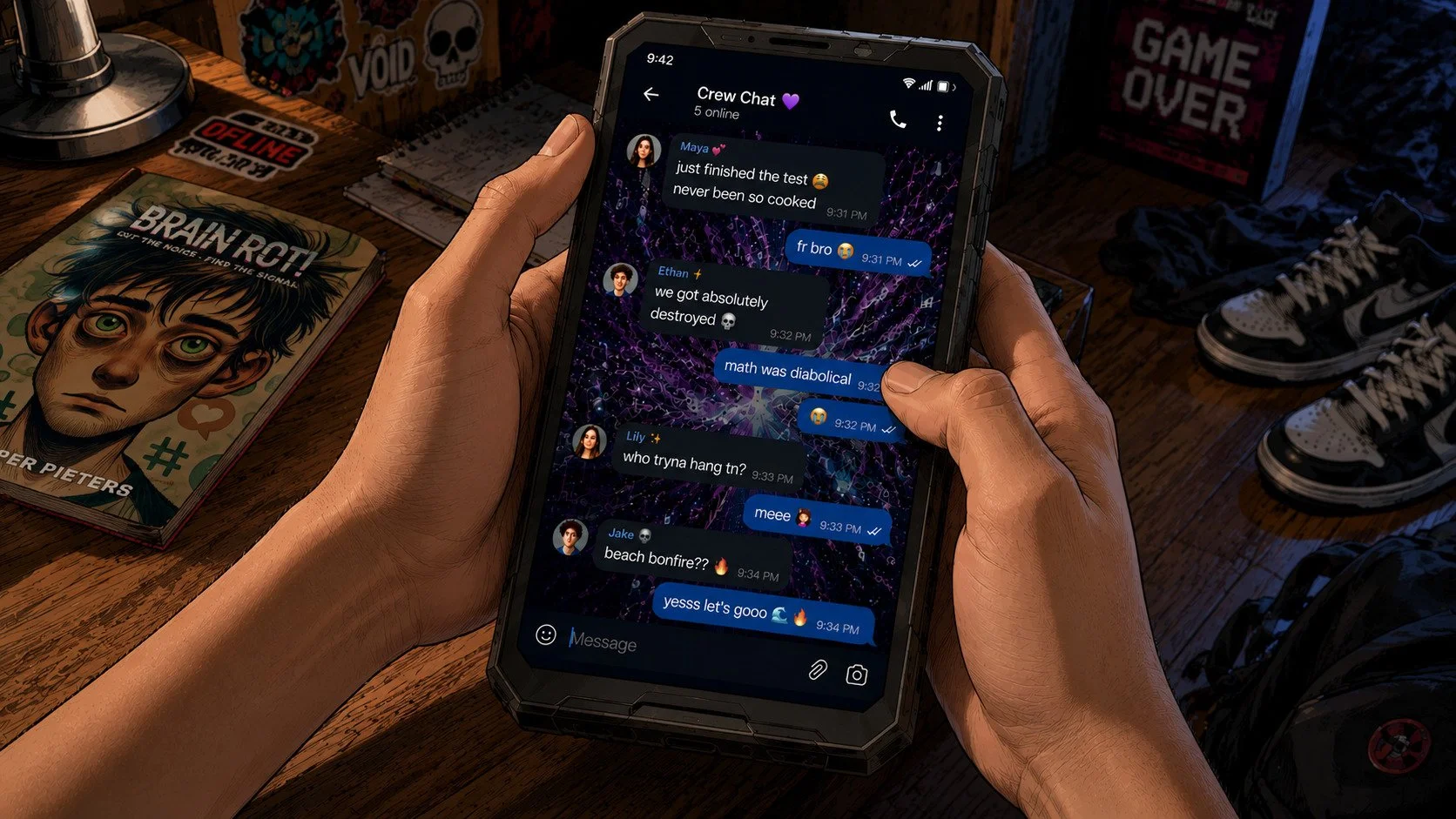
Are Screens Really Shrinking Our Children's Attention Spans?
Many parents have experienced the same scene.
Your child begins their homework.
A notification appears.
A quick glance becomes a scroll.
The scroll becomes a video.
The video becomes another video.
And before long, the homework has disappeared beneath a mountain of digital distractions.
It is easy to conclude that screens have destroyed our children's attention spans.
But the reality is both more complicated and more important.
Recent research* suggests that attention itself may not be disappearing. Instead, the digital environments many young people inhabit are teaching their brains to pay attention differently. Fast-moving platforms filled with endless novelty can condition children to expect constant stimulation, making slower activities such as reading, studying, listening, and deep thinking feel comparatively unrewarding.
This distinction matters because it changes how we respond.
The solution is not simply removing screens.
The solution is helping young people understand how these systems compete for their attention in the first place.
That is precisely the challenge explored in Brain Rot! Cut the Noise – Find the Signal.
The Real Issue Isn't Screen Time
One of the most interesting findings from current research is that attention is not a single thing.
Many young people can spend hours intensely focused on a game, a YouTube creator, or a social media feed.
The challenge emerges when they need to focus on something that offers fewer immediate rewards.
Researchers increasingly describe this as attention fragmentation. Children become accustomed to jumping rapidly between stimuli, making sustained concentration more difficult.
In other words:
The problem is often not that children cannot pay attention.
The problem is that digital platforms are becoming exceptionally good at deciding what they pay attention to.
Enter the Fog
In Brain Rot!, Team Savv-i discovers that something strange is happening.
Students are becoming distracted.
Conversations become shorter.
Decisions become impulsive.
People seem unable to focus on what matters.
The characters call it "The Fog."
The Fog is, of course, fictional.
But it serves as a powerful metaphor for a real-world phenomenon.
Modern recommendation systems continuously learn what captures our attention. They observe what we pause on, what we click, what makes us angry, what makes us laugh, and what keeps us scrolling.
Their goal is not necessarily to help us learn.
Their goal is to keep us engaged.
As researchers have noted, today's digital environment contains an effectively endless supply of attention-grabbing stimuli, particularly challenging for developing brains that are still learning self-regulation and executive function.
In Brain Rot!, the Fog becomes visible.
In real life, it often remains invisible.
That invisibility is what makes it powerful.
Why Story Works Better Than Warnings
Parents often hear advice such as:
"Limit screen time."
"Put the phone away."
"Go outside more."
These suggestions are not wrong.
But they rarely explain why the struggle exists.
Young people are far more likely to engage with an idea when they experience it through story.
When readers follow Bindi, Beam, Mia, Rob, and Chi as they confront the Fog, they do not simply learn facts about persuasive technology.
They experience its effects.
They see friendships strained.
They witness attention being manipulated.
They feel the frustration of losing control over their own choices.
This transforms an abstract concept into something tangible.
Instead of being told that attention matters, readers discover why attention matters.
The Hidden Cost of Constant Switching
Research conducted over the past two decades suggests that people are switching their attention more frequently than ever before. Frequent task-switching is associated with greater stress, more mistakes, and reduced performance because the brain must repeatedly reorient itself to new tasks.
This idea appears throughout Brain Rot!.
The characters gradually realise that every distraction carries a cost.
Every interruption fragments their thinking.
Every pull toward the feed makes it harder to hear their own thoughts.
Eventually, they discover that the most valuable skill is not consuming more information.
It is learning how to choose what deserves attention.
That lesson may be one of the most important forms of digital literacy young people can develop.
What Parents Can Do
The goal should not be raising children who never use technology.
The goal should be raising children who understand technology.
Research suggests several practical approaches:
• Encourage activities that require sustained attention, such as reading, creative projects, and problem-solving.
• Create opportunities for device-free conversations and family interactions.
• Help children recognise how notifications, recommendations, and endless scrolling are designed to capture attention.
• Discuss digital habits openly rather than relying solely on restrictions.
• Use stories as conversation starters about technology's influence on everyday life.
Finding the Signal
The debate about shrinking attention spans will continue.
Some researchers argue that attention itself may not be declining as dramatically as headlines suggest. Others point to growing evidence that certain digital experiences can contribute to attention difficulties, especially when they dominate a child's daily environment.
But perhaps the most useful question is not:
"Are screens shrinking my child's attention span?"
Perhaps the better question is:
"What is competing for my child's attention every day?"
That is the question at the heart of Brain Rot!
Because in a world full of noise, notifications, algorithms, and endless scrolling, success may depend less on avoiding technology and more on learning how to recognise the signal hidden within it.
And that is a skill every young person will need.
* Sources:
Santos, R. M. S., Mendes, C. G., de Oliveira, V. M., et al. (2022). The Association between Screen Time and Attention in Children: A Systematic Review. Developmental Neuropsychology, 47(4), 175–192.
Cardoso-Leite, P., & Bavelier, D. (2021). Media use, attention, mental health and academic performance among children and adolescents. Nature Human Behaviour.
Toth, C., et al. (2025). Associations Between Screen Time, Sleep, and Executive Function in Children and Adolescents. Journal of Clinical Medicine.
Hutton, J. S., Dudley, J., Horowitz-Kraus, T., et al. (2019). Associations Between Screen-Based Media Use and Brain White Matter Integrity in Preschool-Aged Children. JAMA Pediatrics.
Organisation for Economic Co-operation and Development. (2025). How's Life for Children in the Digital Age? The Impact of Digital Activities on Children's Lives.