Rage Bait, Media Literacy, and Why Big Tech Profits When We’re Angry
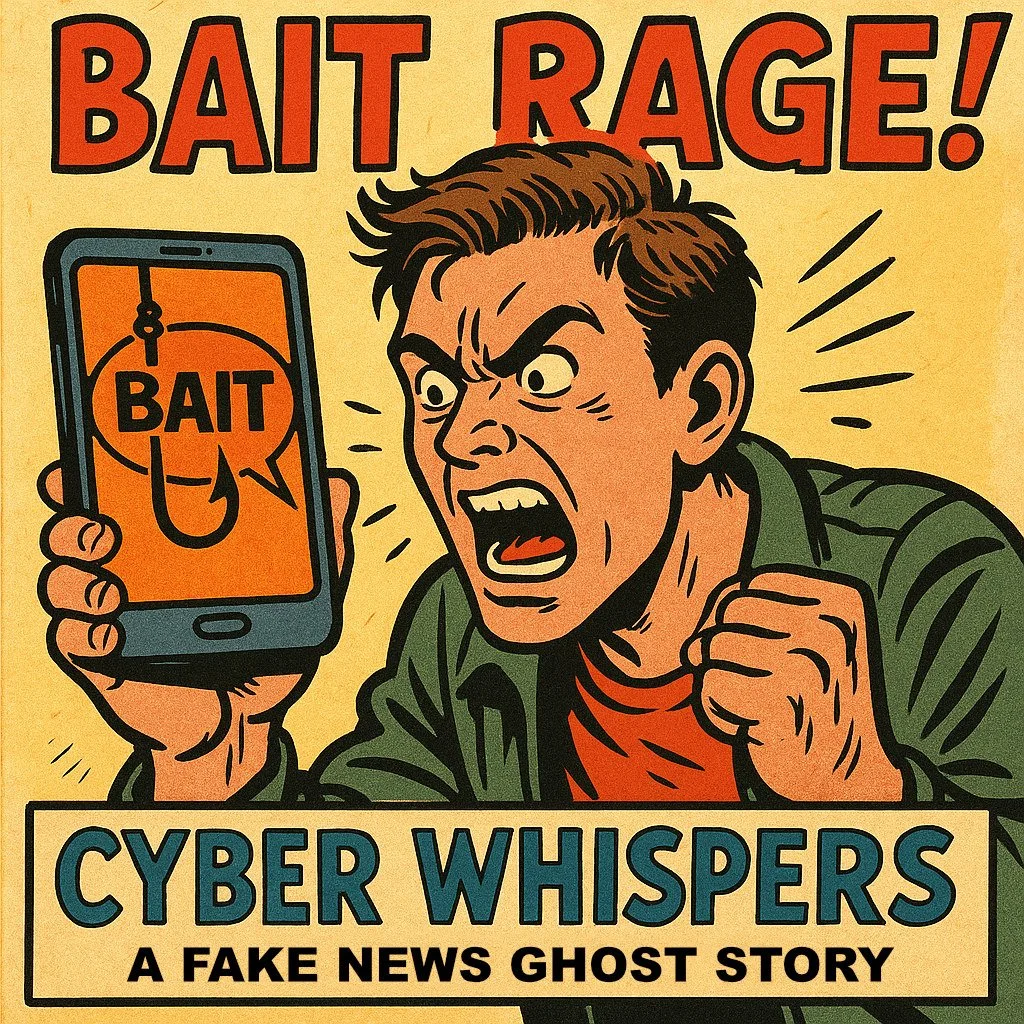
— And How Cyber Whispers Helps Teens See What’s Really Going On
When Oxford University Press declared “rage bait” the 2025 Word of the Year, it wasn’t a celebration. It was a diagnosis.
Rage bait, content designed to provoke anger and negative reactions, has quietly become one of the most profitable engines of the modern attention economy. Rage bait works because it hijacks something ancient in the human brain: our evolutionary sensitivity to threat, conflict, and social danger.
In other words: We pay attention to what makes us angry, and Big Tech makes money whenever we do. But there is good news. By building strong media-literacy habits, and by giving young teens stories that reveal why rage bait exists, we can help a new generation navigate the attention economy with clarity instead of outrage. This is where Cyber Whispers, and other media literacy themed stories, becomes a powerful ally.
Why Rage Bait Works: The Psychology Big Tech Relies On
Rage bait doesn’t spread because humans are inherently hostile. It spreads because anger is:
Fast
Contagious
Sticky
Evolutionarily meaningful
In early human groups, anger signaled threats that required immediate attention. Ignoring it could be dangerous. Today, social media algorithms exploit that same reflex, but instead of protecting us, it’s used to monetise our emotional reactions.
In other words:
Algorithms amplify posts we engage with regardless of whether our reaction is positive or negative.
Negative content spreads faster because our brains interpret anger as urgent.
People online quickly form “anger coalitions,” aligning with those who express outrage.
Because social media is constant, we no longer get the natural breaks that once helped us calm down.
And the business model is simple: More outrage = more engagement = more revenue.
This makes rage bait not an accident of online culture, but a structural feature of how major platforms are built.
Where Media Literacy Makes the Difference
Media literacy helps young people zoom out and see the bigger system at work. Instead of believing that provocative posts represent “the real world,” they learn to notice:
1. Emotional Manipulation
“Why do I feel this way after scrolling?”
“Did this post want to inform me — or inflame me?”
2. Algorithmic Incentives
“Who benefits from me staying angry?”
“Is this post being shown to me because it’s true or because it triggers me?”
3. Performance vs Authenticity
Teens should imagine controversial posters as performers. Once they see “influencers of outrage” as actors playing a role for money, the spell breaks.
4. Power in Choosing What Not to Engage With
Because algorithms learn from every click, comment, and share, even hate-comments, refusing to engage becomes an act of resistance. Teaching these skills is essential. But teens learn most effectively when ideas are embedded in story, not lectures. That is why Cyber Whispers can be so effective.
How Cyber Whispers Helps Teens Understand Rage Bait — Without Preaching
Cyber Whispers immerses young readers in a fictional world shaped by real-world digital dynamics. Instead of telling teens that rage bait is manipulative, it shows them how emotional triggers, viral outrage cycles, and algorithmic incentives play out through compelling characters and escalating plotlines.
Here’s how the story builds true media-literacy insight:
1. The antagonist algorithms behave exactly like real rage-bait systems
In Cyber Whispers, characters confront digital forces that thrive on emotional volatility:
Posts that provoke conflict are surfaced more often.
Negative reactions amplify visibility.
Characters are nudged toward polarised thinking.
Without awareness, we become predictable participants in outrage cycles. Readers begin to see these mechanisms in their own feeds.
2. Characters experience the emotional pull, then learn to step back
Instead of lecturing, Cyber Whispers lets teens feel the tug of rage-driven content.
As characters fall into spirals of:
indignation
provoked responses
algorithmic escalation
…young readers recognise the pattern in themselves. Later, when the characters learn to disrupt those reactions, pausing, reflecting, choosing differently, teens absorb a powerful message:
You can’t stop the algorithm from wanting your outrage,
but you can stop feeding it.
3. The book gives teens a vocabulary to talk about manipulation safely
Just like Brain Rot! introduced “fog,” Cyber Whispers introduces new metaphors that help young people discuss digital manipulation without shame. Teens can say:
“This post feels like whisper-bait.”
“That comment thread is engineered drama.”
“I think the app is pushing me to react.”
Naming the pattern breaks its power.
4. It teaches the one behaviour that weakens rage bait: opting out
Big-Tech algorithms can work in our favour. The more we avoid engaging with content that induces rage, the less it is shown to us.
Cyber Whispers reinforces this idea as characters learn:
that scrolling past is resistance
that silence can be strength
that outrage is the currency they must withhold
Through story, teens understand the real-world impact of their digital choices.
What Young People Can Do — Starting Today
Here are four simple, story-aligned, research-backed strategies:
1. Don’t comment on rage bait — not even to disagree.
Algorithms do not care if you’re furious. Engagement is engagement.
2. Curate your feed intentionally.
Follow accounts that make you think, not accounts that make you react.
3. Pause before responding.
A 3-second delay is enough for your brain’s emotional circuitry to reset.
4. Ask the key literacy question: “Who benefits from my reaction?”
If the answer is “the platform,” you have your cue to disengage.
Hope Instead of Outrage
This is the heart of Cyber Whispers: empowering young people to reclaim their agency.
Parents and teachers using the Cyber Whispers education guide can make teens understand the mechanics behind rage bait, and this stops them being pulled by it. When they stop reacting, Big Tech’s anger-driven business model loses its grip, at least on them.
Conclusion: Awareness Is Power, and Story Is the Bridge
Rage bait is not going away. But our vulnerability to it can.
By combining:
the psychology of emotional manipulation,
strong media-literacy education, and
learning tools like Cyber Whispers,
we can raise a generation that knows how to protect its attention, emotional wellbeing, and digital citizenship.
No teen can fight an algorithm alone, but an informed teen can refuse to feed it.