Why the global AI arms race matters for young people,
and how educators can teach it without fear
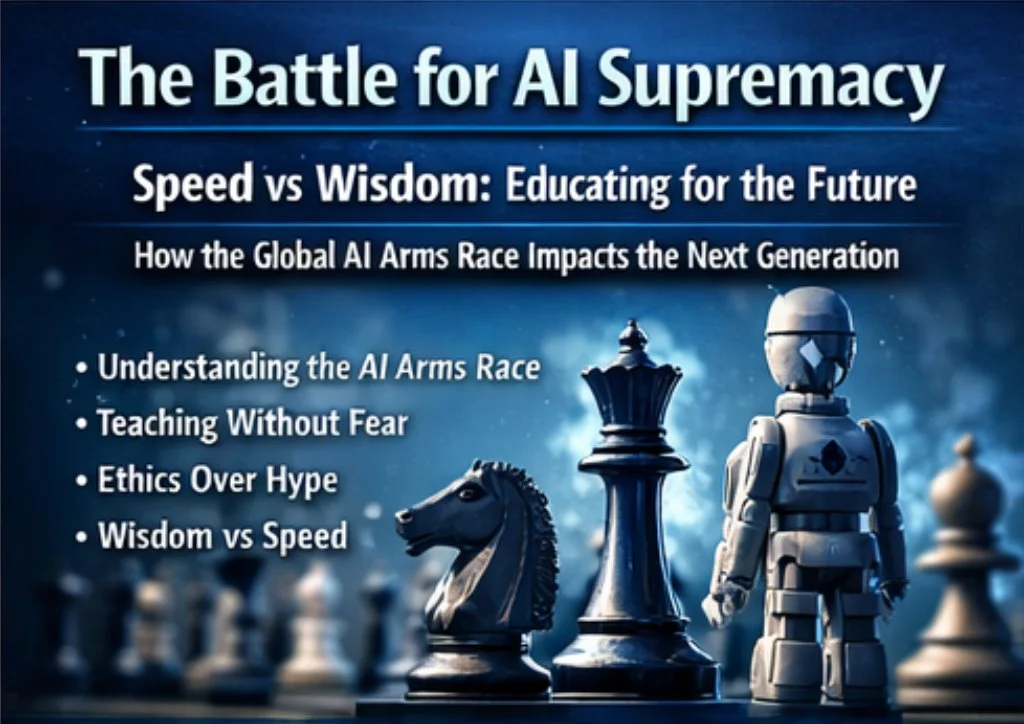
For most of human history, intelligence was our unbeatable advantage. Homo sapiens, literally “wise humans”, survived not because we were strongest or fastest, but because we could think, plan, imagine, and cooperate better than any other species on Earth.
For the first time ever, that assumption is being tested.
Around the globe, nations and corporations are locked in an accelerating race to build ever-more powerful artificial intelligence systems. It is often called “the AI arms race”, not because everyone is building robot soldiers, but because AI capability itself is now treated as strategic power. And like every arms race before it, speed, secrecy, and dominance are beginning to outweigh safety.
What the “global AI arms race” really is
This race is not a single competition. It is a layered struggle for advantage across five interconnected fronts:
1. Compute and chips - Advanced AI depends on rare, highly specialised chips. A single European company, ASML in the Netherlands, holds a near-monopoly on the machines required to manufacture them. These machines are essential for companies like Nvidia, now one of the world’s most valuable corporations. Control of chips has become geopolitical leverage, not just commerce.
2. Frontier models - Labs are racing to create systems that reason, plan, act autonomously, and use tools across many domains. Each breakthrough pressures competitors to move faster or risk irrelevance.
3. Talent and capital - Governments and investors funnel unprecedented money into AI startups and national programs, intensifying the “winner-takes-all” mentality.
4. Standards and rules - Who sets the rules for AI safety, data use, and accountability? Regions that regulate too strictly fear losing ground; regions that regulate loosely become magnets for risk.
5. Military and intelligence integration - AI is increasingly embedded in surveillance, cyber-operations, logistics, and decision support, raising the stakes far beyond consumer technology.
In short: AI capability is now treated as power.
And power, historically, is rarely pursued cautiously.
Why competition puts safety at risk
The danger is not that engineers suddenly “don’t care” about safety. The danger is structural.
Speed beats certainty - AI systems often reveal their failure modes late. But arms-race dynamics reward shipping first, scaling faster, and accepting “manageable risk”, until something goes wrong.
Secrecy replaces scrutiny - Competitive pressure reduces transparency. Training data, internal testing results, and incident reports increasingly stay hidden, making independent oversight harder.
Governance lags behind diffusion - Even when one lab is careful, similar capabilities appear elsewhere, sometimes with weaker safeguards, fewer checks, or more permissive uses.
Scale crowds out caution - Building safer AI requires slow, expensive work: interpretability research, rigorous evaluations, deployment monitoring. In a race, these are the first things squeezed.
Regulatory loopholes emerge - When regions take different approaches, the EU focusing on compliance, the US prioritising speed, others opting for minimal oversight, companies naturally gravitate to the least restrictive environment.
The result is a system that quietly rewards risk-taking, not wisdom.
Why this matters for young people
Today’s children and teens are not just users of AI.
They are:
growing up shaped by algorithmic systems
learning, socialising, and forming identity in AI-mediated environments
inheriting the consequences of decisions being made now
If this race goes wrong, young people bear the cost, through misinformation, surveillance, automation of harm, loss of agency, and systems they never consented to.
Yet flooding them with fear is not the answer.
How educators can teach this without stoking panic
Young learners don’t need apocalyptic narratives. They need context, agency, and ethical framing.
Here’s what works:
1. Frame AI as a human system, not a monster - AI does not “decide” to race. Humans do. Teach students that incentives, economics, and politics shape technology, and can be reshaped.
2. Focus on choices, not doom - History is full of moments where societies slowed, regulated, or redirected dangerous technologies. The AI story is still being written.
3. Use stories, not statistics - Narrative helps young people explore complex systems emotionally and safely. Fiction allows learners to experience consequences without fear-based messaging.
4. Emphasise digital citizenship - Critical thinking, questioning incentives, understanding data use, and recognising manipulation are practical tools students can use now.
5. Highlight “race-to-safety” solutions - Teach that safety is not anti-progress, it is a form of progress:
pre-deployment testing
transparency standards
international cooperation
ethical design requirements
These are not abstract ideals; they are design choices.
The deeper question
The real issue is not whether AI becomes more intelligent. It is whether we remain wise enough to govern what we create. An intelligence race that forgets human safety is not a sign of progress, it is a failure of imagination and responsibility. If we want the next generation to inherit a future shaped with them, not for them, education must move beyond bans, hype, and fear, and toward understanding. Because the most important competition ahead is not between machines.
It is between speed and wisdom, and wisdom still has time to win.