
The Web Trap 5- Day Mini-Unit Pack
What is The Web Trap One-Week Mini Unit Pack?
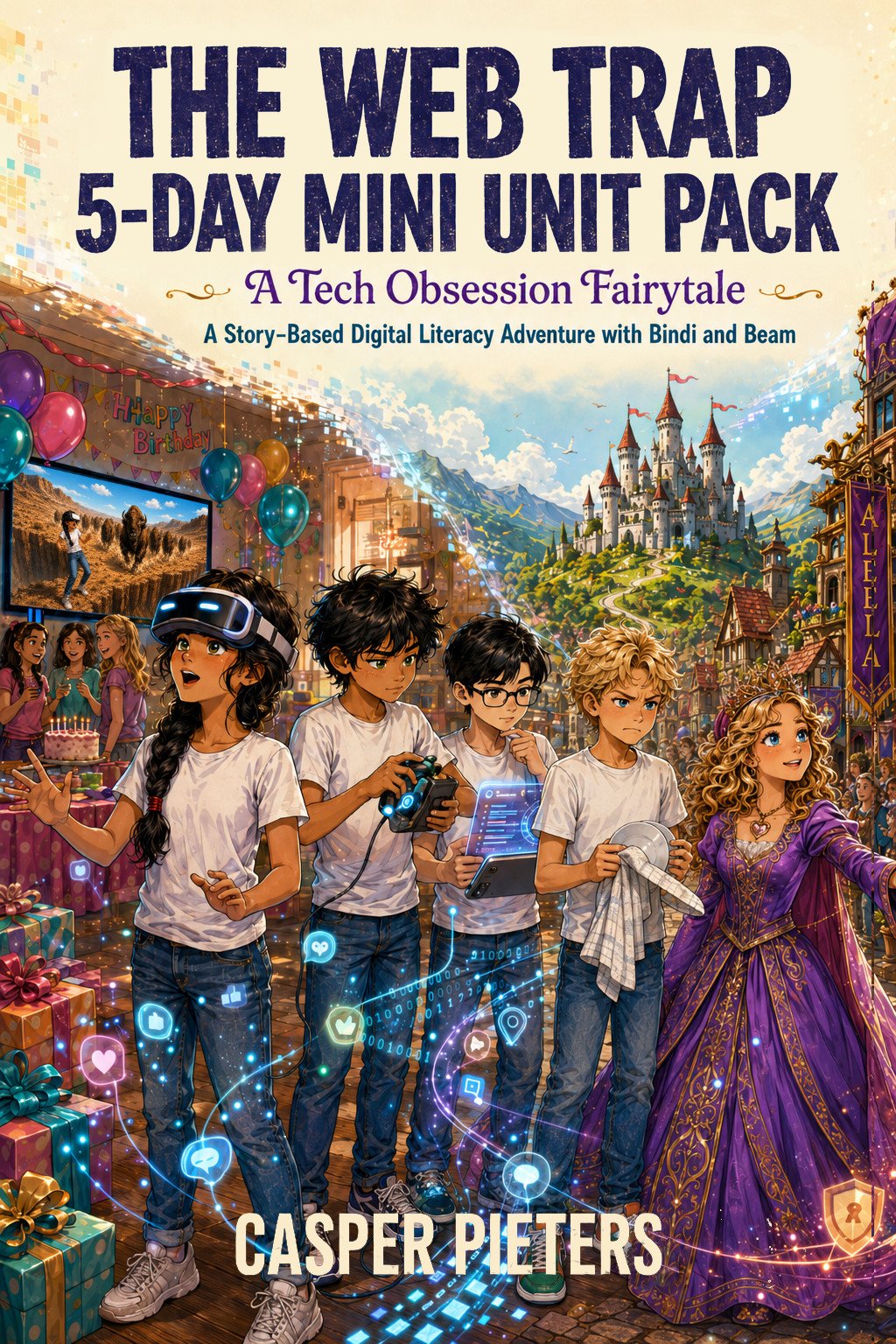
The Web Trap One-Week Mini Unit Pack is a curated, story-led digital wellbeing and literacy program that uses The Web Trap – A Tech Obsession Fairytale and its companion Activity Guide to help young people understand how immersive technology can shift from exciting entertainment into escapism, distraction and social isolation.
Rather than teaching through lectures, warnings or fear-based messages, the unit uses the experiences of Bindi, Beam, Maddy and Jack to make complex ideas about virtual reality, attention, identity, friendship and digital balance concrete, memorable and emotionally engaging.
Students see Bindi experience the overwhelming realism of the DreamWalker, watch Maddy become increasingly absorbed in its virtual world, and follow her transformation into Princess Aleela as the fantasy begins to replace real relationships and even her sense of identity. The story then becomes the springboard for exploring how young people can enjoy technology while protecting their agency, wellbeing and real-world connections.
Methodology
1. Story-Based Learning
Students learn through narrative rather than abstract theory. Instead of simply being told that immersive technology can become difficult to leave, learners watch Maddy move from curiosity and excitement to absorption, avoidance and isolation. They see how the DreamWalker offers her admiration, control, beauty and belonging, while gradually pulling her away from Bindi, her birthday guests and her real-world identity. This allows learners to experience the issue through character choices, consequences and relationships before examining the concepts directly.
2. Inquiry and Discussion
Each day combines selected story passages with guided questions that encourage learners to investigate:
Why virtual experiences can feel so real
How attention can be pulled away from people nearby
Why fantasy identities can become attractive
When enjoyment begins turning into escapism
How technology can affect friendships
What helps people reconnect
How healthy digital balance can be protected
Students are encouraged to explain, question and interpret rather than simply accept rules about screen use.
3. Active Learning
Every lesson includes a hands-on zero-tech activity and an optional technology-supported challenge.
Activities include:
The Immersion Machine
VR Safety Inspector
The Attention Pie
Attention Time-Lapse
The Escape Ladder
Avatar: Promises and Costs
Rescue Route to Friendship
Message from the Real World
Build the Balance Bridge
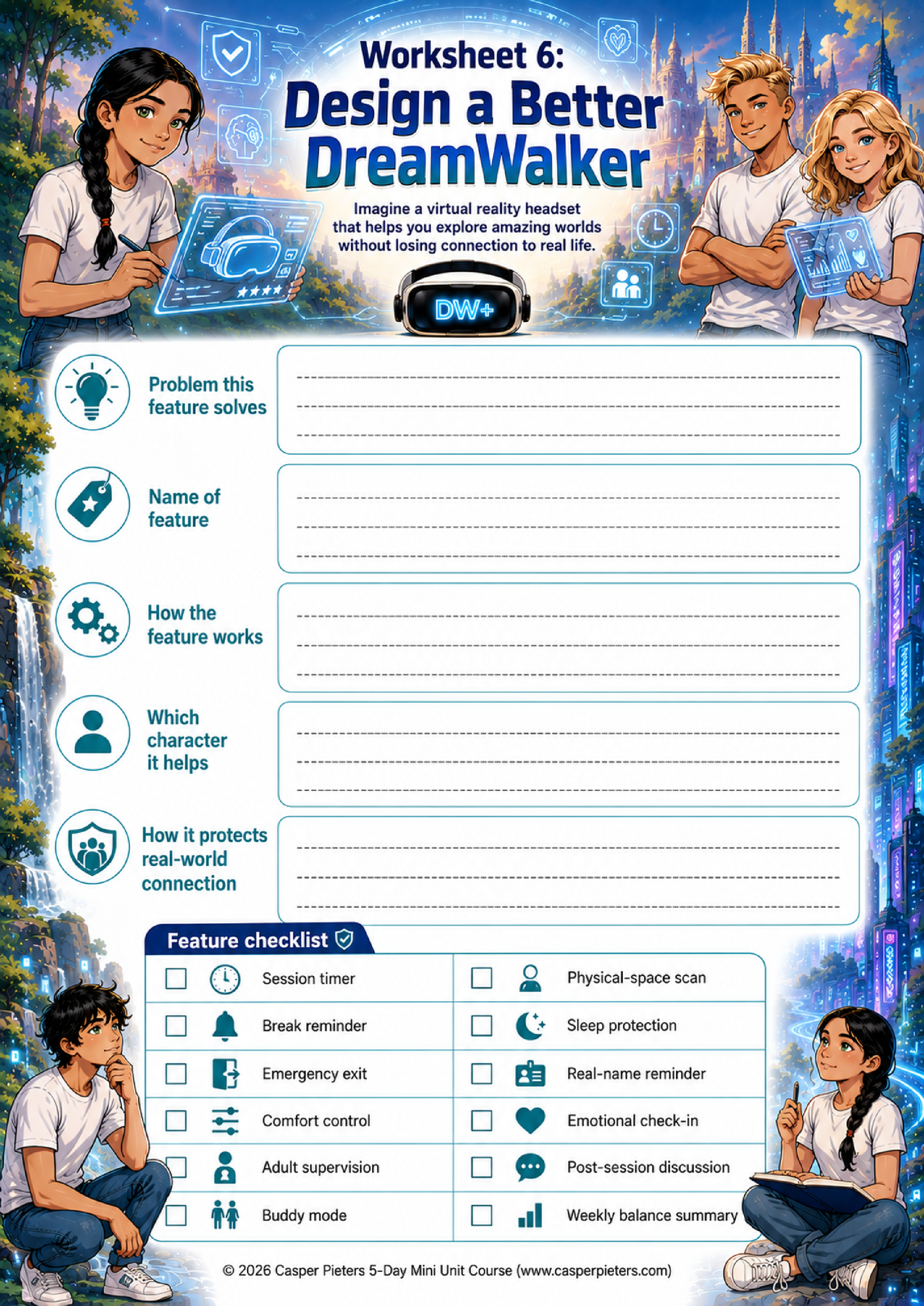
Design a Better DreamWalker
These activities turn ideas such as immersion, attention, identity, escapism and digital balance into visible systems learners can investigate and manipulate themselves.
4. Ethical Design Thinking
The unit does not stop at identifying risks. Learners finish the week by redesigning the DreamWalker with features that support:
safer use;
healthy time limits;
emotional awareness;
real-world connection;
easier stopping;
shared experiences;
user control;
responsible design.
This shifts learners from passive users of technology to thoughtful digital citizens and designers.
Who Is It For?
Homeschool Families
A complete five-day program requiring minimal preparation and suitable for individual learners, siblings or homeschool groups.
Lessons can be completed in one week or spread over a longer period to suit each family’s learning rhythm.
Classroom Teachers
The pack can be used as:
a one-week digital wellbeing unit;
a digital citizenship module;
a technology or media literacy extension;
a Health and Wellbeing learning sequence;
a literature-based cross-curricular unit.
School Librarians and Workshop Facilitators
Ideal for:
digital literacy sessions;
reading enrichment;
media literacy programs;
library learning activities;
wellbeing workshops;
small-group discussion.
Learning Outcomes
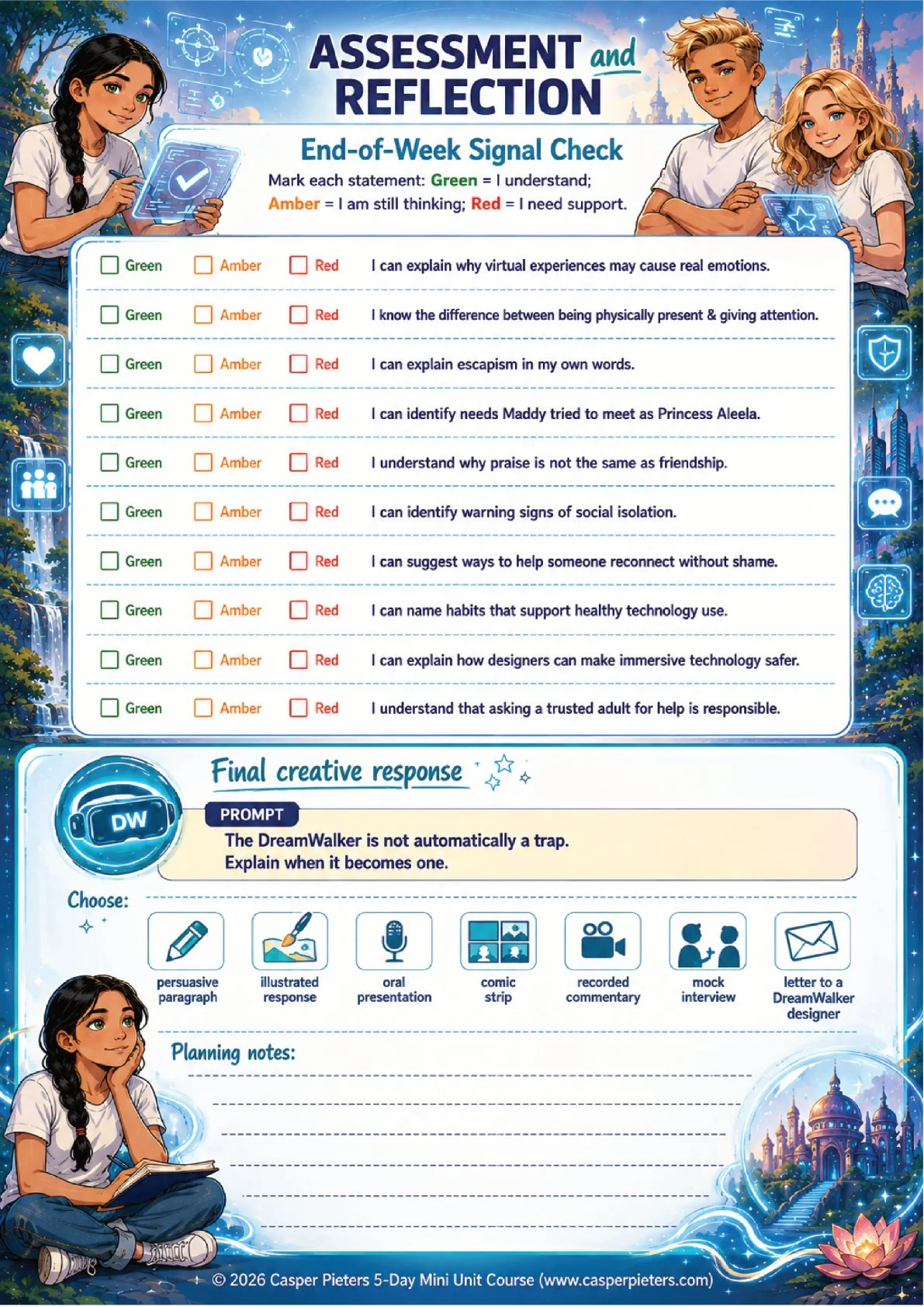
By the end of the unit, learners will be able to:
Digital Literacy
Explain why immersive technology can trigger real emotional reactions.
Recognise how digital environments compete for attention.
Identify features that make virtual experiences difficult to leave.
Understand the difference between digital identity and real-world identity.
Critical Thinking
Trace how curiosity can develop into absorption, avoidance and isolation.
Analyse what virtual environments promise users.
Evaluate the benefits and costs of immersive technology.
Consider different character perspectives and motivations.
Digital Citizenship
Recognise the importance of personal agency.
Identify warning signs of unhealthy technology use.
Develop practical strategies for digital balance.
Understand when to pause, reconnect or ask for help.
Social and Emotional Learning
Explore empathy, friendship and belonging.
Recognise the difference between admiration and genuine connection.
Understand how shared memories and relationships help support identity.
Communicate without shame or judgement when helping someone reconnect.
Ethical Understanding
Consider the responsibilities of technology designers.
Explore how safety and wellbeing can be built into digital products.
Recognise that engaging technology should still allow users to stop easily.
Creative Problem Solving
Design safer immersive experiences.
Develop practical solutions for protecting attention and relationships.
Apply learning from the story to real-world technology choices.
Personal Growth
Ultimately, the unit helps learners explore:
attention;
identity;
friendship;
self-awareness;
agency;
escapism;
digital wellbeing;
healthy boundaries;
responsible decision-making.
The central message of the program is simple:
Technology should add to life, not quietly replace the people, experiences and relationships that make real life worth living.
Through Bindi and Beam’s adventure, learners discover that the goal is not to fear virtual technology, but to understand its pull, recognise when balance begins to disappear, and develop the confidence to remain in control of when they enter, when they leave and what they choose to value.