AI as a Paintbrush: Helping Children Build a Right Relationship with Technology
For many parents, the conversation around artificial intelligence begins with anxiety.
Will AI replace jobs?
Will children stop thinking for themselves?
Will creativity become automated?
Will the next generation become even more dependent on screens?
These are reasonable concerns. But they are not the whole story. There is another side to AI that parents need to see clearly. Not the AI of shortcuts, laziness, plagiarism, or passive consumption. Not the AI that simply produces more content for children to scroll past. But AI as a tool for making, imagining, learning, designing, building, questioning, and contributing.
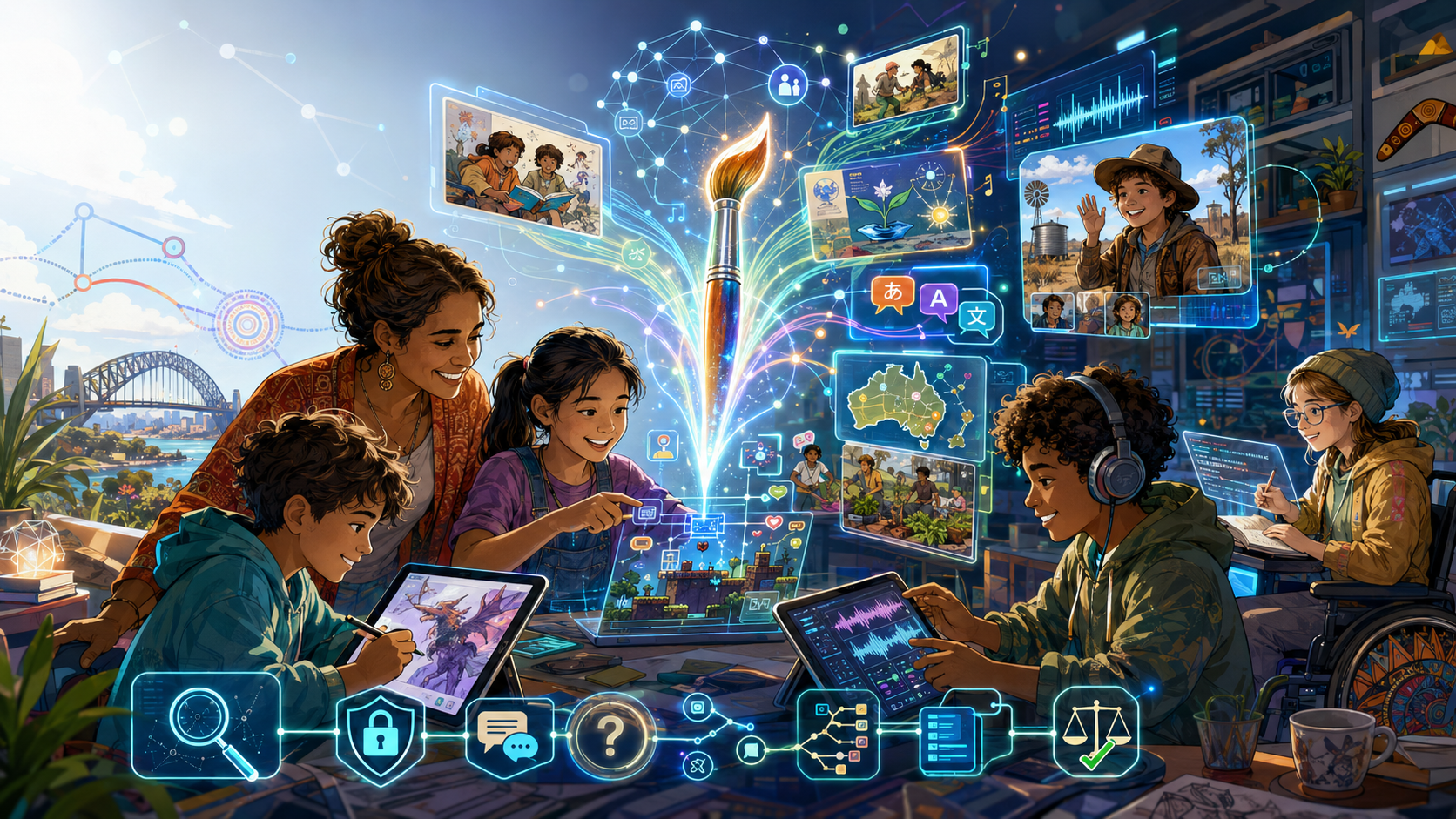
Used well, AI may become less like a conveyor belt and more like a paintbrush.
A paintbrush does not save time. It invites expression. It gives shape to what is already inside a person. It helps a child turn an idea, a question, a worry, or a dream into something visible. That is the positive potential of AI: not merely to make life faster, but to make more people capable of making things.
This matters because human beings are not happiest when they only consume. Children do not usually remember the expensive toy as much as the cardboard box that became a spaceship, castle, secret lab, or dragon cave. They do not only want entertainment handed to them. They want to enter the world of making.
AI, at its best, can lower the barriers to that world.
For most of the digital age, children who could not code, edit video, compose music, design graphics, or build software had to remain consumers of other people’s creations. They could watch, click, like, share, and subscribe. But building was often reserved for those with specialist skills, expensive tools, or adult permission.
AI changes that.
A child with an idea for a game can begin to prototype it.
A reluctant writer can explore characters and plot possibilities.
A visually imaginative child can create concept art.
A young musician can experiment with sound.
A student who struggles with traditional learning can receive explanations in different forms until the idea finally clicks.
A child in a remote community can access support, translation, tutoring, creative tools, and learning opportunities that were once out of reach.
That is an enormous shift. The most hopeful version of AI is not a world where children do less. It is a world where more children can finally do more. But this positive future will not happen automatically.
Children need AI literacy.
They need to understand that AI is not magic, not a friend with perfect wisdom, and not a replacement for their own judgment. They need to know how to question it, guide it, test it, challenge it, and use it responsibly. They need to understand bias, privacy, authorship, originality, persuasion, misinformation, and the difference between assistance and dependence. Most importantly, they need to learn that technology is not only about the individual. It is also about community.
This is where stories can help.
The Bindi and Beam and Team Savv-i series were written from the belief that children should not meet technology only through warnings, rules, or fear. They should meet it through adventure, friendship, mystery, humour, danger, consequence, and choice. In these stories, technology is never presented as simply good or bad. It is powerful. It can trap, distract, deceive, manipulate, and divide. But it can also connect, reveal, create, protect, and solve problems when young people learn to use it with courage and wisdom.
Bindi and Beam introduces younger readers to the emotional and imaginative side of technology. The stories help children recognise when digital experiences become too absorbing, when games or virtual spaces begin to pull them away from real relationships, and when courage means stepping back, asking questions, and choosing friendship over fascination.
Team Savv-i takes older readers further. Across the series, the characters confront cyberbullying, fake news, persuasive design, privacy risks, digital commerce, online identity, artificial intelligence, and the attention economy. They do not simply defeat villains. They learn to read systems. They begin to understand that behind every app, platform, device, and algorithm, there are choices, incentives, values, and consequences.That is the groundwork for a right relationship with technology.
A right relationship with technology does not mean rejecting it. It means refusing to be ruled by it.
It means children learn to ask:
What is this tool asking from me?
Who benefits if I keep using it?
What is it doing with my attention?
What is it doing with my data?
Does it help me become more capable, or more dependent?
Does it help my community, or only entertain me?
Am I using this to create, connect, and contribute or only to consume?
These are the questions young people will need in an AI-shaped world. The positive potential of AI is real. It may help young people turn side interests into skills, questions into projects, and private ideas into shared creations. It may help students who have been left behind by one-size-fits-all education. It may give children with different learning needs new ways to access knowledge. It may allow rural, remote, and under-resourced communities to participate more fully in the creative and digital economy.
But opportunity without literacy is not empowerment. It is exposure.
Children who do not understand AI may become passive users of systems designed by others. Children who do understand AI can become active shapers of their own learning, creativity, and future work. That is why AI literacy belongs beside reading, writing, numeracy, media literacy, and digital citizenship. It is becoming part of how young people will think, make, work, communicate, and participate in society.
Parents do not need to become AI experts overnight. But they do need to help their children move beyond the two unhelpful extremes: panic and blind enthusiasm.
The better path is guided curiosity.
Let children experiment, but ask them what the tool is doing.
Let them create, but talk about originality and effort.
Let them use AI for support, but ask where their own thinking begins.
Let them explore its power, but teach them to notice its limits.
Let them see AI not as a shortcut around learning, but as a companion in deeper learning.
The future will not reward children who merely know how to press buttons. It will reward those who know how to ask better questions, shape better prompts, recognise weak answers, protect their privacy, collaborate ethically, and use powerful tools for meaningful purposes.
In the end, the best argument for AI is not that it will make everything faster.
The best argument is that it may help more children become builders.
Builders of stories.
Builders of solutions.
Builders of communities.
Builders of futures that would otherwise have remained locked inside them.
That is the hopeful side of AI. And it is why children need stories like Bindi and Beam and Team Savv-i: not to frighten them away from technology, but to prepare them to meet it with imagination, responsibility, and courage. Because the question is no longer whether young people will use AI.
They will.
The real question is whether they will use it as consumers of other people’s systems, or as thoughtful creators who know how to build, question, protect, and contribute. That is the relationship with technology worth teaching.