Teaching children why is more powerful than simply telling them no.
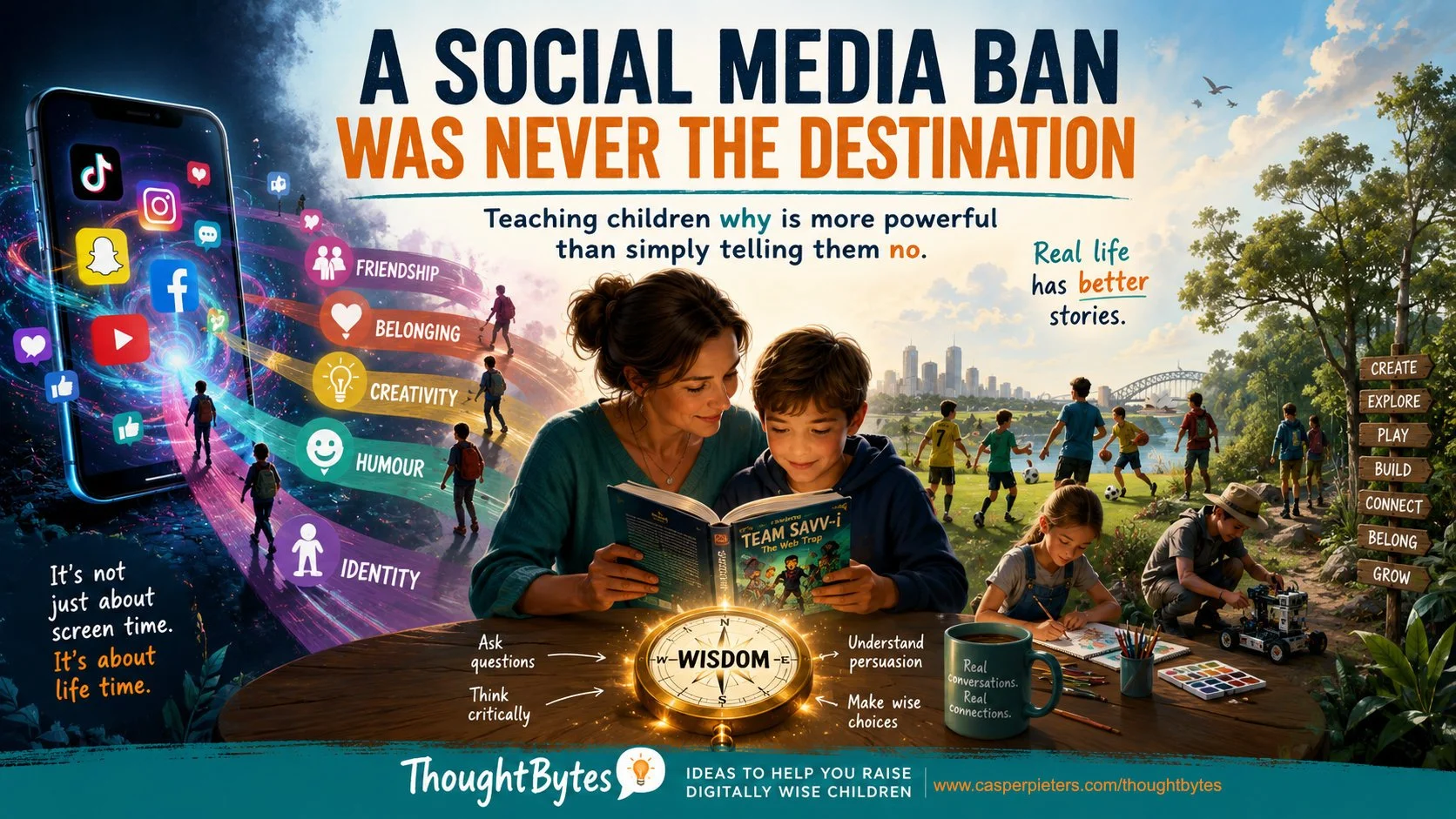
AI generated image
I still remember how quickly my own children could spot a loophole. If there was a way around a rule, they would usually find it—not because they were bad children, but because children are naturally curious, resourceful and determined. Every parent knows this.
That is why I wasn't particularly surprised when Australia's first evaluation of the under-16 social media ban showed that many young people were still finding ways to access social media.
The real surprise would have been if they hadn't.
According to the Australian Government's 2026 eSafety Commissioner Social Media Minimum Age Compliance Update, around 81% of children aged 10–15 were still using social media three months after the legislation came into effect, compared with approximately 86% before the ban. At the same time, the proportion of children with their own social media accounts dropped from 52.4% to 42.1%, showing that the legislation had prompted platforms to remove or restrict millions of accounts.
The report also found that more than half of young people said they had never been asked to verify their age, while about one-third admitted they simply entered a false birth date when creating an account.
Those statistics tell us something important.
The challenge isn't simply technology.
It's human nature.
The Wrong Question
Much of the public discussion has centred on whether the legislation is working.
That is a reasonable question.
But I believe there is a more important one.
Why do so many young people feel they need social media in the first place?
Children don't join social media because they enjoy algorithms.
They join because they are looking for friendship.
For belonging.
For entertainment.
For identity.
For somewhere to express themselves.
Social media has become woven into the social lives of many young people. It offers connection, creativity, humour, learning opportunities and communities that can be genuinely valuable. For some young people, especially those with specialised interests or limited local social networks, it can provide meaningful support and a sense of belonging.
Yet these benefits exist alongside real risks.
The same platforms are deliberately designed to compete for attention. Recommendation algorithms reward engagement rather than wisdom. Features such as endless scrolling, personalised feeds, notifications and social feedback can encourage longer and more frequent use. Young people may also encounter cyberbullying, inappropriate content, unrealistic social comparison, misinformation and unwanted contact.
Recognising both the benefits and the risks helps explain why this issue is so complex. If we only talk about the dangers, we miss why social media is so appealing. If we only celebrate the positives, we ignore why so many parents, educators and policymakers are concerned.
That is why simply removing access was never likely to solve the whole problem.
Rules Cannot Replace Understanding
Laws have an important role.
Platform accountability matters.
Age verification matters.
Parents matter.
Schools matter.
But none of these can replace understanding.
Eventually every young person reaches the point where no filter, parent or law is standing beside them. At that moment, the only protection they have is their own judgement. That judgement is built long before they are handed a phone.
It grows through conversations.
Through experience.
Through reflection.
Through learning to recognise manipulation before becoming part of it.
Why I Chose Story Instead of Lectures
People sometimes ask why I write adventure stories instead of simply producing books that explain digital citizenship. The answer is simple. Stories answer questions that facts alone cannot. A child can be told that algorithms shape what they see. But when they watch Beam become trapped inside a digital world… When they follow Team Savv-i as they uncover how persuasive technology quietly influences choices… When they experience cyberbullying, misinformation or privacy dilemmas through characters they have come to care about…
The lesson becomes personal.
Story creates context.
It allows children to experience consequences safely before they encounter similar situations in real life. Instead of asking, "Will this be in the test?", they begin asking, "What would I do?"
That is the kind of question that changes behaviour.
It is the reason I call my work Edufiction.
Not education wrapped in a story.
But education that grows naturally from the story itself.
We Must Also Build Better Alternatives
Perhaps the biggest lesson from the eSafety report is not that young people found ways around the rules. It is that we need to think much more carefully about the role social media has come to play in childhood. If social media meets needs for friendship, creativity, entertainment and belonging, then simply removing it leaves an empty space.
Nature dislikes a vacuum.
So do children.
The real challenge for parents, schools and communities is to create alternatives that are every bit as engaging, rewarding and socially meaningful. That may include family read-alouds, sport, music, drama, coding for creation rather than consumption, outdoor adventures, volunteering, maker projects, youth groups, hobbies, face-to-face friendships and opportunities for children to solve real problems together.
The aim is not merely to reduce screen time. It is to increase opportunities for children to build confidence, competence and connection in the real world.
Preparing, Not Just Protecting
I believe Australia's social media legislation has begun an important national conversation. Whether the law ultimately proves highly effective or only partly effective, it has drawn attention to a much bigger issue. Children need more than restrictions.
They need wisdom.
They need digital literacy.
They need opportunities to question persuasive technology rather than simply consume it.
Most of all, they need adults who are willing to walk beside them as they learn.
My hope is that every story I write helps families have one more meaningful conversation about the digital world, not because children are told what to think, but because they begin to understand why wise choices matter. In the end, our goal should never be simply to keep children away from technology. It should be to raise a generation that knows how to use technology with discernment, confidence and purpose—long after the rules no longer apply.
References
Australian eSafety Commissioner. (2026). Social Media Minimum Age: Compliance Update. Australian Government.
Australian eSafety Commissioner. Social Media Age Restrictions Evaluation. Australian Government.
Australian Government. (2024). Online Safety Amendment (Social Media Minimum Age) Act 2024.
American Psychological Association. (2023). Health Advisory on Social Media Use in Adolescence.
National Academies of Sciences, Engineering, and Medicine. (2024). Social Media and Adolescent Health.