Meta’s $18 Billion Settlement: Will It Really Change the Business of Capturing Young People’s Attention?
The fine makes headlines. The restrictions placed on the machinery behind Facebook and Instagram may matter more.
By Casper Pieters | ThoughtBytes
When I first read that Meta had agreed to a settlement worth up to US$18 billion over claims involving young social-media users, my reaction was fairly cynical. Eighteen billion dollars sounds devastating until you put it beside the size of Meta. The company reported US$200.97 billion in revenue for 2025 (Meta, 2026). Even the maximum settlement represents less than one-tenth of that annual revenue. Meta has survived privacy scandals, congressional hearings, regulatory investigations and enormous fines before. I see little reason to believe that another large financial penalty, by itself, will change the company that owns Facebook and Instagram.
Then I began looking more closely at what Meta had actually agreed to do.
That changed my view somewhat.
The interesting part of this settlement is buried beneath the dollar figure. Regulators are starting to interfere with the design decisions that help social-media companies hold a young person's attention. For parents and educators, that deserves a much closer look.
The argument has moved inside the product
We have spent years discussing online safety largely in terms of harmful content. Pornography. Cyberbullying. Self-harm material. Predators. Hate speech. All serious problems. But anyone who has watched a teenager flick through an endless feed knows that content is only half the story. There is also the feed itself.
Why doesn't it end?
Why does another video begin without being requested?
Why does a phone announce that something has happened on an app that hasn't been opened for an hour?
Why does one video about a particular subject soon become five, then fifteen?
Those things were designed.
Under the settlement approved on August 26, Meta agreed to a default two-hour combined daily limit for under-18 users of Facebook and Instagram, restrictions on access between midnight and 6 a.m., reduced notifications, stronger age checks and independent oversight of compliance (Novak Jones, Stempel & Bensinger, 2026).
Two hours is hardly a radical digital detox. Parents can override some controls. Teenagers will undoubtedly find ways around others. Still, the restrictions reach somewhere previous regulation has often struggled to reach: into the mechanisms used to keep people on the platform. The European Commission has been even more explicit. Its July 2026 preliminary findings against Meta named infinite scroll, autoplay, push notifications and highly personalised recommendation systems when examining what it called the "addictive design" of Facebook and Instagram (European Commission, 2026a).
That phrase, addictive design, is worth dwelling on.
For a long time we have expected children to develop the self-control necessary to resist products whose designers have considerable financial incentives to make resistance difficult. As an educator, I have never been comfortable with that arrangement. We keep telling the child to put the phone down. Adults can be remarkably contradictory about children's technology use. We hand young people devices containing some of the most carefully tested attention-capturing systems ever developed, then become frustrated when they have trouble stopping.
"Just put it down."
I suspect many parents have said it. Probably most teachers have thought it. But putting the phone down isn't occurring in a neutral setting. A notification can call the child back. A recommendation algorithm chooses what appears next. Autoplay removes the small decision involved in starting another video. Infinite scroll removes the stopping cue provided by reaching the bottom of a page. None of these features forces a teenager to continue. But neither should we pretend that they have no influence on behaviour.
Persuasive technology works in those small moments between one decision and the next. There doesn't need to be a villain sitting in Silicon Valley plotting to addict a particular 13-year-old. A company needs only to optimise a product for engagement and become extremely good at it. The business incentive does the rest.
Follow the attention
Meta's business makes the connection unusually easy to see. In 2025, advertising accounted for the overwhelming majority of its revenue (Meta, 2026). Advertising needs an audience. An audience that stays longer offers more opportunities to show ads and gather behavioural information that can improve subsequent targeting and recommendations. So time spent on a platform has commercial value. This is why I think restrictions on notifications, recommendations and usage time could eventually matter more than the billions Meta has agreed to pay. They touch the resource upon which the system depends: people's attention.
There is an awkward complication here, though. Instagram cannot become considerably less absorbing for teenagers while every competitor continues as before without risking young users simply moving elsewhere. The Meta settlement appears to recognise this. Roughly 30 per cent of Meta's maximum financial commitment depends on TikTok and YouTube adopting comparable safeguards and making matching payments. If that occurs, Meta has agreed to tighten its own controls further, including a one-hour-per-app limit and longer overnight restrictions (Novak Jones, Stempel & Bensinger, 2026).
Competition has helped create the attention race. It may take regulation across competitors to slow it.
Something else has changed
There is a legal question underneath all this that could prove more troublesome for technology companies than the settlement itself. Section 230 of the US Communications Decency Act has historically provided online platforms with substantial protection from liability arising from content posted by their users. But what if the alleged harm comes from something the company designed? That question is now being tested.
The Ninth Circuit recently rejected an attempt by Meta and TikTok to halt thousands of lawsuits at an early stage. The ruling did not find the companies liable. It dealt with whether Section 230 prevented the litigation from proceeding at that point (Novak Jones, Stempel & Bensinger, 2026). That distinction is easy to lose in reporting on these cases, and it is important not to claim more than the courts have actually decided. Elsewhere, however, regulators are already going directly after design.
TikTok faced a preliminary European Commission finding in February 2026 concerning features including infinite scroll, autoplay, push notifications and its recommendation system (European Commission, 2026b). Facebook and Instagram followed in July. I used to think the central regulatory battle would remain mostly about harmful material: what platforms should remove, how quickly they should remove it and who should decide. I'm less convinced of that now. The more interesting battle may be over the machinery that decides what arrives next and how hard the product works to prevent the user from leaving.
Brazil is worth watching. One reason I hesitate to treat the Meta settlement as an isolated American event is what is happening elsewhere. Brazil's ECA Digital came into force in March 2026. Its approach goes well beyond asking companies to provide parents with another settings menu. The legislation and accompanying rules address age assurance, safer defaults, parental supervision and design features associated with compulsive use (Agência Gov, 2026). Brazilian regulators have also shown some appetite for enforcement. On August 25, Brazil's National Data Protection Authority fined ByteDance R$153.7 million over violations involving children's and adolescents' personal data. TikTok was ordered to delete data the regulator said had been improperly collected and to implement a compliance plan (ANPD, 2026). Brazil is pursuing Discord too, including demands involving age verification, parental supervision and safer defaults.
Some of these measures will be challenged. They should be. Governments can get technology regulation wrong as readily as companies can get product design wrong. Age verification in particular creates an uncomfortable problem: protecting children online can require platforms to become better at establishing who everyone is. That carries privacy risks of its own. There is no tidy solution here.
But Brazil, Europe and the United States are arriving at a similar place through rather different legal routes. The design of children's digital experiences is becoming a legitimate subject for regulation.
So will this make social media safer?
I hope so, but we do not know whether Meta's new restrictions will produce measurable improvements in adolescent mental health. A court settlement cannot establish that. Nor does a two-hour timer dismantle Meta's advertising model. Algorithms remain. Advertising remains. Personalisation remains. The commercial value of engagement remains.
And young people are resourceful. Anyone who has worked with teenagers knows what happens when an adult designs a rule and assumes the rule has therefore solved the problem.
The restrictions could nevertheless reduce some of the constant digital nudging. Fewer overnight notifications means fewer invitations back into an app. Usage limits introduce a stopping point where previously there wasn't one. Restrictions on recommendation systems could reduce some of the momentum that carries a young user from one piece of content to the next. Small interruptions can matter when a product has been designed to remove interruption. Whether they matter enough remains to be seen.
What concerns me now is what comes after the obvious tricks.
Persuasive technology isn't going away because regulators have discovered infinite scroll. If anything, artificial intelligence makes the next generation of persuasive systems more interesting and, frankly, more worrying. A platform that learns not merely what millions of teenagers like, but what this particular teenager responds to, at this particular moment, has a much finer instrument for capturing attention.
The crude techniques are easy to recognise once someone points them out. A streak is a streak. Autoplay is visible. A notification makes a sound. AI-driven personalisation is harder to see. The child experiences a feed that simply seems unusually interesting.
That is one reason I don't believe regulation can replace education. I wrote Brain Rot! and its associated learning resources to provide this understanding in a way that is accessible for young teens. When I began developing the Brain Rot! story and its learning activities, I kept returning to a problem I had encountered throughout my years as an educator: warning young people about technology is rarely enough. Tell a 13-year-old that social media is "bad for you" and you haven't taught much. I would rather have that young person pull the persuasive technology machinery apart by following the main characters and see what happens to them.
Why did the app send that notification?
What does it know about me?
What happens when I hesitate over one video but swipe immediately past another?
Why is there no bottom to the feed?
Who makes money from the extra twenty minutes I spend here?
That last question tends to change the conversation.
The Brain Rot! learning system grew from this approach. The adventure story gives young teens something concrete to argue about. The Read-Aloud Kit, 5-Day Mini-Unit, illustrated novella and now the short animation video plus activities let them investigate persuasive design, recommendation loops and the economics sitting underneath apparently "free" digital services.
I don't want a child leaving one of those activities frightened of technology. I want them to become slightly harder to fool.
We have put too much of a burden on ourselves and our children
For years, digital citizenship education has quite reasonably taught children to behave responsibly online. Use a strong password. Don't bully. Check your sources. Protect private information. Think before posting. Balance screen time with the rest of life. I still teach those ideas. But look at how much responsibility sits with the child in that list.
The Meta case introduces another actor into the lesson: the designer.
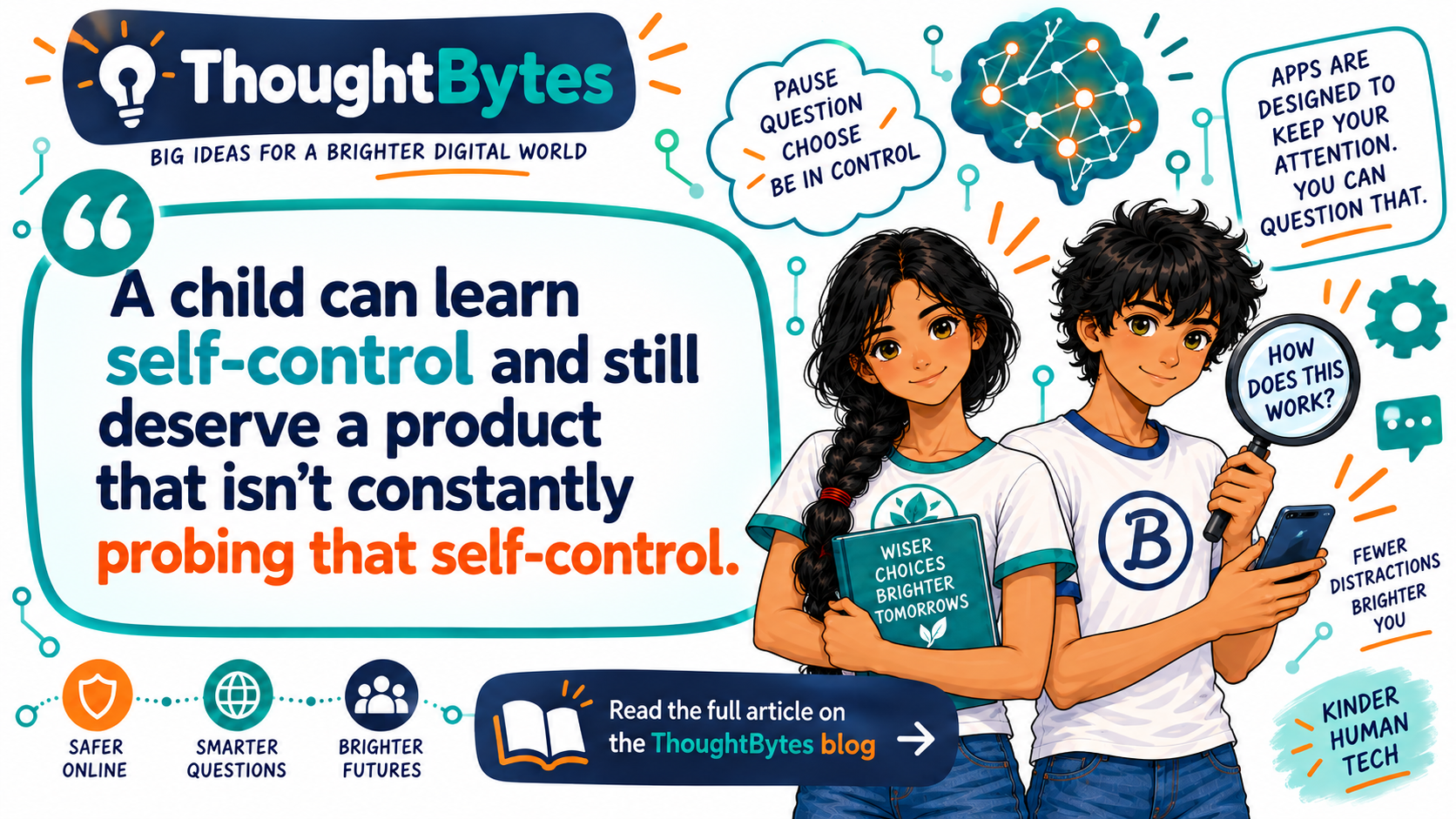
A child can learn self-control and still deserve a product that isn't constantly probing that self-control. A parent can establish sensible household rules without having to fight an algorithm every evening. A school can teach digital literacy without accepting that commercial platforms should be free to use every available behavioural trick on their students.
Perhaps the lasting value of the Meta settlement will be surprisingly mundane.
A timer.
A quiet phone at midnight.
A feed that eventually gives a child a reason to stop.
None sounds revolutionary. They shouldn't be. They should have been ordinary features of products used by children in the first place. The $18 billion will eventually disappear into financial reports and legal accounts. What I will be watching is much less dramatic:
whether these restrictions actually reduce engagement.
whether competing platforms are forced to follow.
whether regulators continue moving deeper into product design and, most importantly,
whether companies begin designing differently because they know someone outside the company may eventually ask why a particular feature was built.
If that happens, the persuasive-technology business model won't be dead. But for the first time, some of its most profitable assumptions about young people's attention may no longer be entirely its own to make.
References
Agência Gov. (2026, March 17). ECA Digital começa a valer com regras de proteção para crianças e jovens na internet. Government of Brazil.
Autoridade Nacional de Proteção de Dados (ANPD). (2026, August 25). ANPD multa TikTok em R$ 153,7 milhões por falhas na proteção de dados de crianças e adolescentes. Government of Brazil.
European Commission. (2026a, July 10). Commission preliminarily finds the addictive design of Instagram and Facebook in breach of the Digital Services Act. European Commission.
European Commission. (2026b, February 6). Commission preliminarily finds TikTok's addictive design in breach of the Digital Services Act. European Commission.
Meta Platforms, Inc. (2026). Meta reports fourth quarter and full year 2025 results. Meta Investor Relations.
Novak Jones, D., Stempel, J., & Bensinger, G. (2026, August 26). Meta agrees to pay $18 billion to settle US lawsuits over children's social media addiction. Reuters.