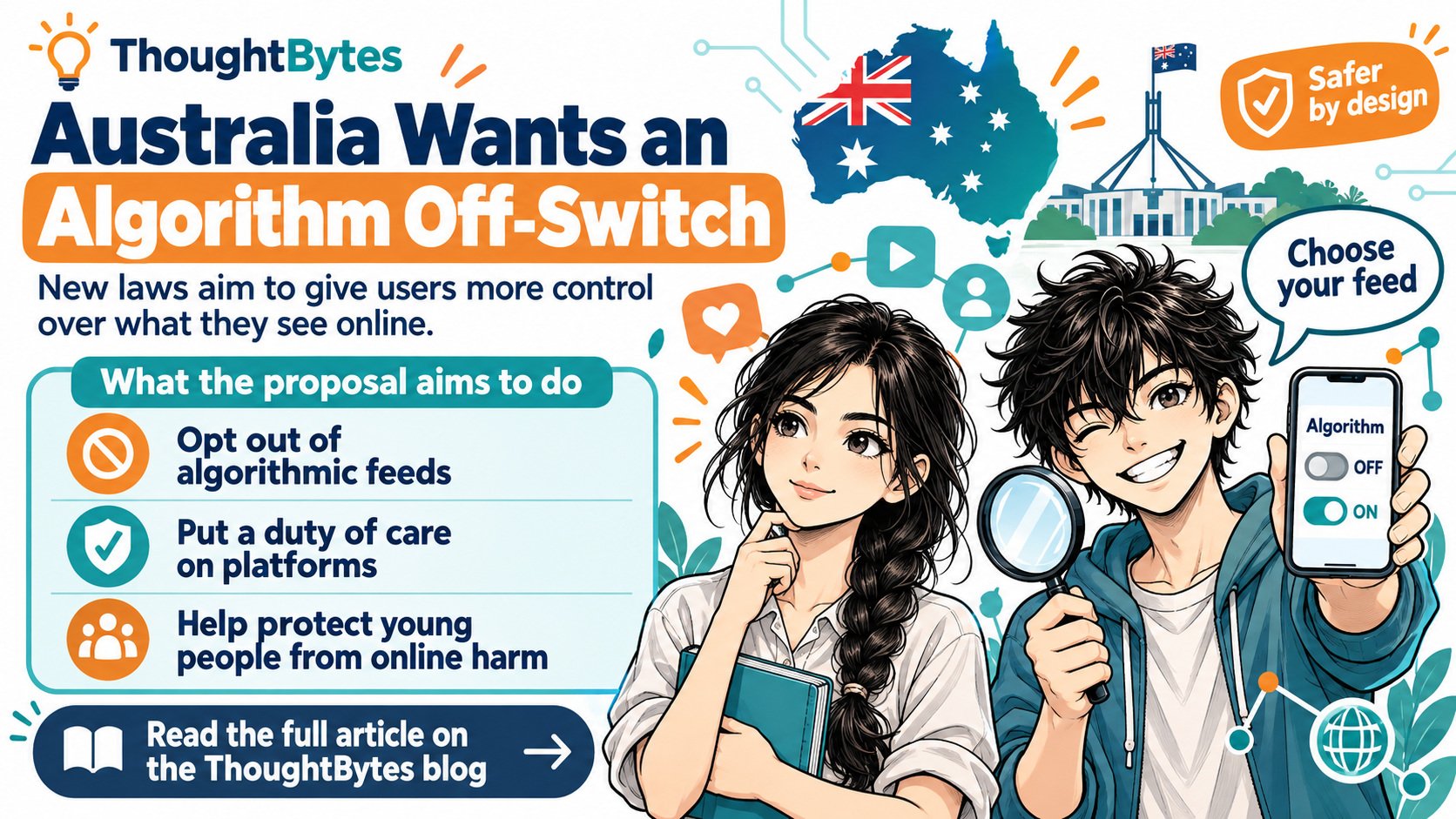
Australia’s proposed Digital Duty of Care takes aim at something sitting underneath the social-media experience: the recommendation system deciding what comes next.
By Casper Pieters | ThoughtBytes
A few days ago, I wrote about Meta’s US$18 billion settlement and why I thought the most interesting part of the case had little to do with the money. Regulators were beginning to reach inside the product. Now Australia is proposing something that takes that idea considerably further. Under draft legislation expected to be released this week, social-media companies would have to regularly ask Australian users whether they want an algorithmically curated feed or would prefer to see posts from accounts they have chosen to follow. The proposal forms part of the federal government’s long-awaited Digital Duty of Care (Speers, 2026).
That sounds like a settings change.
I don't think it is.
If implemented properly, an algorithm opt-out challenges one of the assumptions on which modern social media has been built: that the platform gets to decide what you see next.
What happens when you turn the algorithm off?
Imagine opening a social-media app and mostly seeing posts from the people and organisations you deliberately chose to follow.
Your cousin.
A friend from school.
Your football club.
An illustrator whose work you enjoy.
Then you reach the end of the recent posts. Nothing particularly revolutionary there. In fact, older readers may recognise something rather familiar. Social media used to work much more like this.
Today's recommendation feeds are different. They can draw upon a user's previous behaviour and other signals to predict which piece of content is most likely to keep that person engaged. Australia's eSafety Commissioner describes recommender systems as technologies that select, filter and personalise what users encounter. eSafety also notes that social platforms commonly prioritise engagement when ranking content and that these systems may not distinguish particularly well between positive and negative engagement (eSafety Commissioner, 2026a).
That last point deserves attention. A recommendation system doesn't necessarily need to decide whether something makes a teenager happier, calmer, kinder or better informed. It needs a useful prediction about whether they will engage with it.
Anger can do that.
Curiosity can.
Anxiety can.
So can insecurity.
This is where persuasive technology stops being an abstract technology topic and becomes something parents should understand.
The proposal puts a choice back where it belongs
According to ABC political correspondent David Speers, the proposed system would require regular pop-ups asking users whether they want to continue using the algorithmic feed or see content posted by people they follow (Speers, 2026).
I like the simplicity of that. Not because algorithms are inherently bad. They aren't. Recommendation systems can help people find useful information, music, communities and creators they might never discover by themselves. eSafety itself acknowledges that recommender systems can produce benefits as well as harms (eSafety Commissioner, 2026a).
The problem is the default.
When a system is designed to maximise engagement, the interests of the user and the interests of the platform can diverge. The user may want to spend ten minutes checking friends' posts. The platform benefits if ten minutes quietly becomes forty-five. Giving someone an off-switch makes that conflict visible.
For a young person, it can also provoke a useful thought:
Hang on. Who was choosing my feed before I made this choice?
That's a digital-literacy lesson hiding inside a pop-up box.
Australia is also proposing something bigger than an opt-out.
The algorithm provision will probably attract most of the headlines, but the Digital Duty of Care may be the more consequential part of the legislation. The ABC reports that the proposal would shift responsibility towards platforms themselves, requiring companies to identify risks, minimise them and prevent foreseeable online harms. For under-18s, the proposed regime would recognise additional forms of psychosocial harm, including harms involving body image and bullying. Companies could face penalties exceeding $100 million for breaches (Speers, 2026). This fits with the direction Australia has already been taking. The eSafety Commissioner describes the proposed Digital Duty of Care as placing the onus on digital platforms to proactively keep Australians safer and prevent online harms.
That word proactively does a lot of work. Much online-safety regulation has traditionally operated after something goes wrong. A harmful post appears. Someone reports it. The platform reviews it. Perhaps it disappears. A duty-of-care model asks an earlier question.
What did the company do when designing the service to reduce the likelihood of that harm occurring?
For persuasive technology, that could matter considerably. Australia is building several pieces at once. It would be easy to look at the algorithm proposal in isolation. I think that misses what Australia is attempting. Australia already has its social-media minimum-age regime. eSafety says those restrictions are intended partly to protect young Australians from design features that encourage more screen time while serving content that can harm health and wellbeing. The regulator is currently evaluating that policy through a study involving more than 4,000 children and families over more than two years (eSafety Commissioner, 2026b).
There are age-restricted material codes.
There are stronger enforcement powers.
There is growing regulatory attention on recommender systems.
Now there is a proposed Digital Duty of Care and an algorithm opt-out.
Put these together and you can see the outline of Australia's approach.
Keep younger children away from some social-media environments.
Make platforms more responsible for foreseeable harm.
Give regulators greater visibility into what those platforms are actually doing.
And give users more control over whether an engagement algorithm controls their feed.
The government proposal isn't law yet, and its details will matter enormously. But the direction is becoming difficult to miss.
The regulator may even be able to behave like a child. One proposal buried in the ABC report particularly caught my attention.
The eSafety Commissioner and registered independent researchers would be able to use so-called "sock puppet" accounts, posing as children to examine what platforms actually recommend to young users (Speers, 2026). I can see why platforms may dislike this. I can also see why regulators want it. There is a fundamental problem when investigating personalised recommendation systems: my Instagram is not your Instagram. Two people can open the same app and encounter remarkably different worlds. A regulator inspecting a company's written safety policy doesn't necessarily learn what a 14-year-old boy who has watched several particular videos will be shown tomorrow night.
A controlled research account can ask a different question. Show me what the system actually does. For a regulator dealing with algorithms, that distinction between stated policy and observed behaviour is important.
There is already disagreement over how far Australia should go
This debate won't be politically tidy. The Coalition has expressed concerns that algorithm regulation could stray into censorship. Shadow Communications Minister Sarah Henderson has previously criticised the psychological manipulation of children through algorithms, while Shadow Treasurer Tim Wilson has argued that algorithms can reflect content people actually want to see. Opposition Leader Angus Taylor has said the Coalition wants parents to have more control but has expressed scepticism about the government's proposal before seeing the legislation (Speers, 2026).
The Greens want to go further. Senator Sarah Hanson-Young introduced the Online Safety Amendment (Fix Our Feeds) Bill 2026 in April. It would require social-media services to allow users to opt out of recommended algorithmic content and impose risk-assessment, reporting and mitigation obligations on online services. That bill remains before the Senate.
There is an interesting difference between requiring an opt-out and making algorithmic feeds opt-in.
With opt-out, personalised recommendations remain the normal experience until the user changes them.
With opt-in, the user actively chooses to enter that experience.
Anyone familiar with persuasive design will recognise why defaults matter. Many people never change them. For children especially, I think that distinction deserves serious debate. But don't confuse an algorithm off-switch with turning off persuasion. Here is where I am more cautious. Switching off a recommendation algorithm does not dismantle persuasive technology.
A platform can still have:
Notifications.
Likes.
Streaks.
Autoplay.
Social rewards.
Influencer marketing.
Read receipts.
Endless scrolling.
Visible popularity metrics.
There are dozens of ways to encourage return visits and prolonged use. And an algorithmic feed itself is not necessarily harmful. A badly designed chronological feed can still contain dreadful material; a carefully designed recommendation system can surface genuinely useful information. The harder question is what the system has been optimised to achieve. That is why I find the duty-of-care component more interesting than a simple "algorithm on/off" debate. If regulators begin asking companies to identify foreseeable harms created by their design choices, they start getting closer to the commercial machinery underneath social media.
We should also be careful about what counts as "choice"
Suppose Instagram asks a 15-year-old:
“Would you like to continue receiving personalised recommendations?”
And underneath sits a large, colourful YES button. The alternative is grey, smaller and described as providing a "less personalised experience". Technically, there is a choice. Behaviourally, there is a distinct nudge. Anyone serious about algorithmic choice therefore needs to look at the interface through which that choice is offered. The opt-out itself must not become another piece of persuasive design. This sounds like a small detail. It isn't. Big Tech has spent years learning how button placement, wording, colour, timing and defaults affect behaviour. Regulators will need to learn that language too.
I keep coming back to what we teach the child. There is a temptation when governments introduce stronger online-safety laws to think that perhaps young people won't need to understand as much about these systems. I reach the opposite conclusion.
Imagine a teenager seeing this proposed pop-up:
Algorithmic feed ON / OFF
I want that teenager to know what they are choosing.
What does the algorithm know about me?
Why did it recommend this?
What happens to my feed if I watch this video twice?
Why am I seeing content from somebody I never followed?
What does the platform gain if I stay another twenty minutes?
And what might change if I switch recommendations off for a week?
Those are much more interesting questions than simply telling a young person to reduce their screen time. They turn the technology into something that can be examined. That is precisely the thinking behind the Brain Rot! learning system I've been developing. Through the story, Read-Aloud Kit, 5-Day Mini-Unit, animation and activities, young teens investigate persuasive design and recommendation loops instead of simply being warned about them. The aim isn't to produce children who fear algorithms. It is to produce young people who know that an algorithm has an objective, and who think to ask what that objective is.
Perhaps we should try the experiment ourselves
If Australia's proposal becomes law, I would like families to do something with that algorithm switch rather than merely acknowledge another pop-up. Turn it off. Try a week. Keep a rough note of what changes.
Did you spend less time on the app?
Did it become boring?
Did you miss discovering new things?
Did you feel less angry, anxious or distracted?
Did you actively search for things rather than waiting for the feed to supply them?
And then turn it back on. Not because one setting is automatically correct, but because the difference between the two experiences teaches something that no lecture about algorithms can quite reproduce. You notice the machine when the machine stops.
Australia's proposed law is still only a proposal. The exposure draft needs scrutiny, Parliament will argue over it, industry will respond, and some provisions may change considerably before anything becomes law. So I wouldn't declare victory over Big Tech. I wouldn't even call it close. But there is something encouraging in a government asking whether Australians should be able to say:
No thanks. I'll choose what I want to see.
For an industry built on becoming increasingly good at choosing for us, that is quite a useful little button.
References
eSafety Commissioner. (2026a). Recommender systems and algorithms — Position statement. Australian Government.
eSafety Commissioner. (2026b, February 26). eSafety begins evaluation of Australia’s world-first social media minimum age. Australian Government.
eSafety Commissioner. (2026c). Social media age restrictions. Australian Government.
Parliament of Australia. (2026). Online Safety Amendment (Fix Our Feeds) Bill 2026. Parliament of Australia.
Speers, D. (2026, September 6). Opt-out laws for social media algorithms to be introduced to parliament. ABC News.