AI Literacy Must Begin Before the Classroom Door
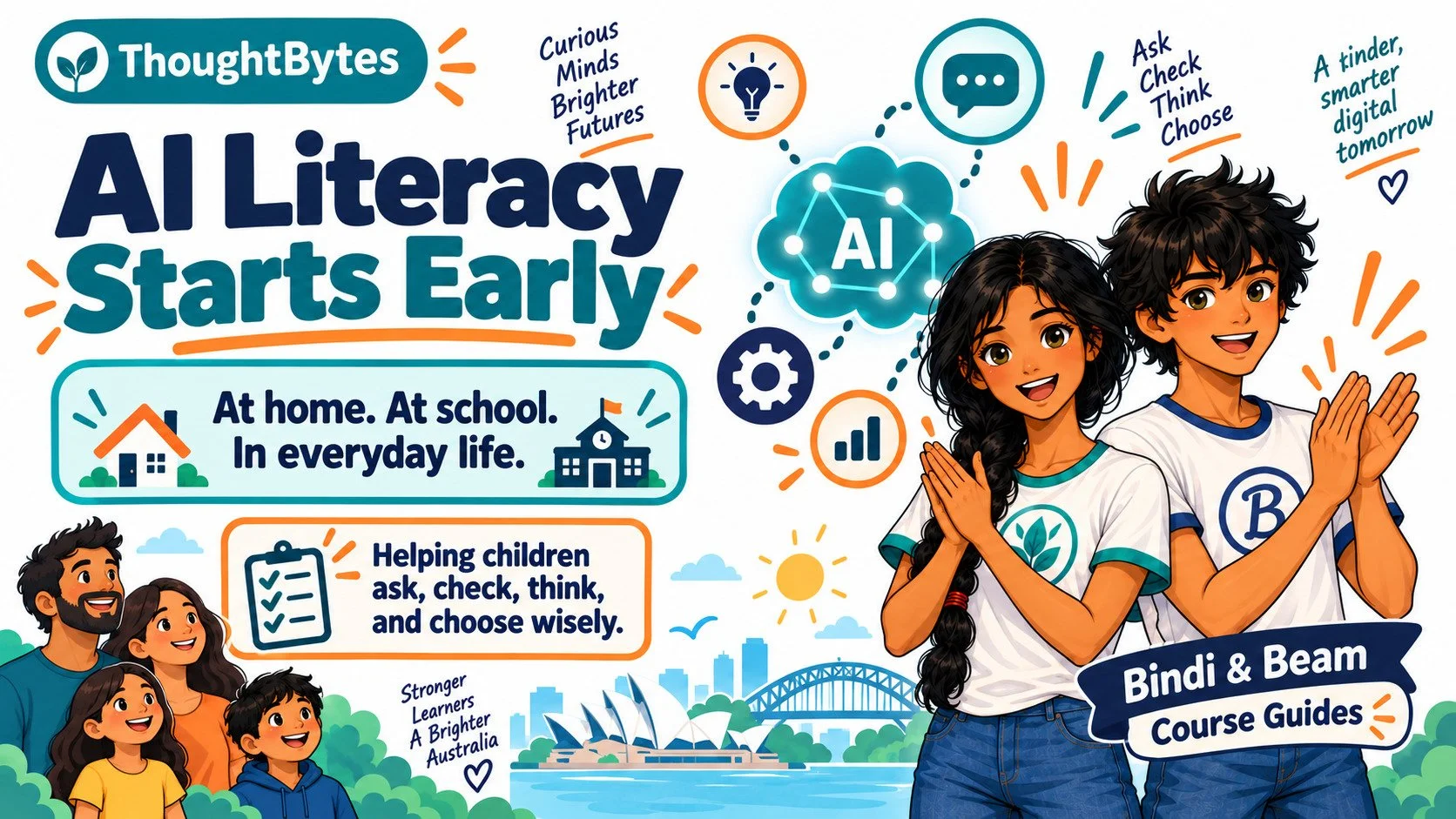
AI literacy needs to start early, at home as well as at school. But knowing how AI works is only half the job. Children also need the character to decide what they should do with it. A child opens an AI chatbot and asks it to do their homework. Another asks the same chatbot to explain the bit of the homework they cannot understand.
Same technology. Same access. Quite different learning.
This is where I think much of our discussion about artificial intelligence and children is going wrong. We are understandably preoccupied with access: whether schools should permit AI, restrict it or ban it; whether students are old enough to use particular tools; whether AI belongs in the classroom at all.
Those questions matter. Erin Mote recently argued in Forbes that removing AI from schools could deepen inequality because children with good devices, connectivity and knowledgeable parents will continue learning about AI at home, while others may lose one of the few places where they can explore it under guidance (Mote, 2026). Her article focuses on the United States, but the underlying problem travels rather well. A child growing up in Sydney, Nairobi, Jakarta, Manchester or a village in rural India is entering a world where artificial intelligence will increasingly mediate information, work, entertainment, communication and decision-making.
The more interesting question, then, is not simply whether children get access to AI.
It is what they learn to do once they have it. And that brings us somewhere technology discussions do not always go comfortably: character. Being able to use AI is not the same as understanding it. We have made this mistake before. A generation became extraordinarily competent at using smartphones and social media. Swiping, uploading, searching and messaging became almost instinctive. Technical confidence did not automatically bring an understanding of persuasive design, recommendation algorithms, privacy, misinformation or the commercial value of personal data. AI could follow the same path.
UNICEF Innocenti reports that artificial intelligence is already part of children's everyday experience through search, recommendation algorithms, chatbots and online learning. Children are using these systems to find information, complete schoolwork, acquire skills and seek advice (UNICEF Innocenti, 2026). So waiting until secondary school, university or the workplace to begin talking about AI makes little sense. The technology has already arrived at childhood's front door.
Children need some understanding of what sits behind the friendly chat box. They should know that an AI system can produce an answer that sounds beautifully confident and still be wrong. They should understand that its response depends on data, design choices and instructions. They need to recognise that generated images and voices complicate the old habit of believing something because we can see or hear it.
The OECD and European Commission describe AI literacy as a combination of knowledge, skills and attitudes that allows people to understand how AI works, critically evaluate its outputs and use it ethically and creatively (OECD & European Commission, 2026). That word attitudes deserves more attention. Knowledge tells a child that an AI system can fabricate information. Character helps the child care whether the information is true.
The question behind the question
Suppose a 13-year-old has an assignment due tomorrow. They are tired. They have football training. The blank document is sitting on the screen. They know perfectly well that an AI system can write the essay in twenty seconds. What part of "AI literacy" matters now? Certainly they need technical knowledge. They need to know what the system can do and where its limitations lie. But the important decision is no longer technical.
Do I hand in something I didn't really write?
Do I ask AI to help me understand the topic instead?
Do I use it to challenge my argument?
Do I tell my teacher how I used it?
Do I struggle with the difficult part myself because that struggle might actually be the point of the assignment?
No lesson about prompt engineering can answer those questions on its own. They involve honesty, responsibility, self-control and judgement. This is why I believe AI literacy and character education need to grow together.
The Jubilee Centre for Character and Virtues describes character through intellectual, moral, civic and performance virtues, brought together through phronesis, or practical wisdom: the judgement required to decide what is appropriate in a particular situation (Jubilee Centre for Character and Virtues, 2022). Practical wisdom is remarkably close to what children will need around AI.
There will never be a rule for every possible situation.
Start early. That doesn't mean handing a six-year-old a chatbot. When I argue that AI literacy should begin early, I am not suggesting an AI product for every primary classroom. Much of the early work requires no AI at all.
Ask a child questions like:
How do you know?
Where did that information come from?
Could somebody have changed this picture?
Why might an app want to know your location?
If two websites tell you different things, what could you do?
Would it be fair to pretend that somebody else's work was yours?
What information about your family should stay private?
Could a computer make an unfair decision?
These are small conversations. They build habits.
UNESCO's student AI competency framework places a human-centred mindset and the ethics of AI alongside technical understanding and AI system design (Miao, Shiohira & Lao, 2024). UNESCO's guidance on generative AI also argues for age-appropriate use and the protection of human agency rather than introducing technology simply because it is available (Miao & Holmes, 2023). I find that reassuring because children's preparation for AI does not have to begin with mastering AI terminology. It can begin with curiosity. And doubt. And the confidence to say, "I'm not sure that's true."
The kitchen table matters
Schools have an enormous part to play here, particularly because access is uneven. That inequality is global. A new UNICEF Innocenti study drawing on consultations with children aged 9 to 17 in the Democratic Republic of the Congo, Egypt, Mozambique, Senegal and Rwanda found that children themselves recognise how device costs, connectivity and infrastructure can restrict their ability to benefit from AI. The report argues for affordable internet access and device availability while also warning that programmes need to fit local cultures, languages and infrastructure rather than assuming that one model of AI education will work everywhere (UNICEF Innocenti, 2026). Schools therefore matter as places where access and guided learning can meet. But home matters for a different reason.
The messy ethical questions usually do not arrive as curriculum objectives. They arrive when a child asks whether they can use AI for tonight's assignment. When a convincing video appears in the family group chat. When a daughter wants to upload a photograph to an AI image generator. When a son says the chatbot told him something that doesn't sound quite right.
Parents do not need a degree in computer science to have these conversations.
Sometimes the useful response is simply: "I don't know. Let's check."
That sentence contains a surprising amount of AI literacy. It shows that certainty should be earned. A family could ask an AI system something they already know well and then examine the answer together. Where did it get the information? Can the claim be checked? Did it invent anything? Does asking the question differently alter the response? Or give it an ethical problem and disagree with it. Children should see adults questioning machines. They should also see adults put machines away. Sometimes the struggle is the lesson
There is a danger at the other end of this debate.
We could become so anxious about children being left behind that we encourage them to use AI for everything. That would be an odd definition of preparation. Writing a paragraph is slow when you are twelve. Working through a maths problem can be irritating. Searching several sources for an answer takes longer than asking a chatbot. Remembering facts requires effort. So does forming an argument. We should be careful before designing all that friction away.
Some of the work AI can remove is precisely the work through which a young mind develops.
If a student writes a paragraph and asks AI, "Where is my reasoning weak?", the machine may become useful intellectual resistance.
If the machine writes the paragraph first, the student may never form the reasoning.
Those two uses can look almost identical from across a classroom. Educationally, they are miles apart. A genuinely AI-literate young person should therefore be able to make a decision that sounds almost absurd in a technology lesson:
"I could use AI for this, but I don't think I should."
That is agency. There is money in this too. Children will eventually encounter another reason to become AI literate: employers will expect it. PwC's 2026 Global AI Jobs Barometer found that jobs specifying AI skills were growing far faster than the overall jobs market in its analysis, while workers with AI skills attracted an average wage premium of 62 per cent (PwC, 2026).
That deserves attention.
It just shouldn't become the whole argument.
We are educating children for lives, not merely vacancies. The young people learning about AI today will encounter it when they work, certainly. They will also encounter it when they shop, date, vote, study, create, watch the news, manage money, raise children and make decisions about other people. A teenager who can operate AI efficiently but cannot recognise manipulation is poorly prepared. So is one who can generate a flawless presentation but cannot distinguish evidence from fabrication. Or someone who knows every clever prompt trick but has never developed the habit of asking whether using the tool is fair.
The economic divide Mote worries about is real. I suspect another divide will sit beside it. A judgement divide. Access can be equal while judgement is not. Imagine two children with identical laptops and access to the same AI system.
One checks important claims. The other assumes confident language means accuracy.
One understands that giving a chatbot personal information carries a cost. The other treats it like a private friend.
One uses AI to probe an idea. The other uses it to escape the effort of having one.
One spots when a generated photograph feels suspicious and goes looking for its origin. The other shares it.
The difference between these children cannot be measured in broadband speed. Giving both of them better technology will not close it. UNICEF's current guidance on AI and children includes privacy, fairness, transparency, children's wellbeing, inclusion and preparation for an AI-shaped future among its requirements for child-centred AI (UNICEF, 2025).
Those protections matter. Children also need something that cannot be installed through a software update: habits of mind.
Curiosity without gullibility.
Confidence without unquestioning certainty.
Honesty when nobody is checking.
Consideration for the person on the other side of the screen.
Enough self-control to resist an easy shortcut occasionally.
And the willingness to change your mind when the evidence says you were wrong.
None of those qualities belongs exclusively to AI education. Which is precisely the point. We have a short window to do this differently. Social media taught us something uncomfortable. Children can become extremely competent users of a technology long before adults have helped them understand the forces working underneath it. For years we tended to deal with problems after they appeared.
Cyberbullying happened; then came the lesson.
Someone shared something intimate; then came the privacy conversation.
Children disappeared down algorithmic rabbit holes; then we started asking how recommendation systems worked.
Misinformation spread; then we talked about checking sources.
With AI we have a chance to get ahead of at least some of that. I don't mean predicting every harm. We won't. I mean making questions about AI normal while children are still forming their habits. At home as well as at school. Not frightening them. Not worshipping the technology either.
Talking about it.
Trying it.
Challenging it.
Laughing when it produces nonsense.
Checking when something matters.
Putting it away when thinking for ourselves would be better.
There is a temptation to define the AI-ready child as the one who can use the newest tools. I would use a different measure.
Can this young person decide when AI deserves their trust?
Can they recognise when another human being deserves their consideration?
Can they use a powerful tool without quietly handing responsibility for their choices to it?
And when the machine gives them the easy answer, do they still know how to think?
If we can help children develop that kind of judgement, we will have taught them something far more durable than prompting.
We will have helped them grow up ready to live with AI without allowing AI to do the growing up for them.
Bibliography
Jubilee Centre for Character and Virtues. (2022). The Jubilee Centre Framework for Character Education in Schools. University of Birmingham. The framework describes intellectual, moral, civic and performance virtues and their relationship with practical wisdom.
Miao, F., Holmes, W. (2023). Guidance for Generative AI in Education and Research. UNESCO, Paris.
Miao, F., Shiohira, K., & Lao, N. (2024). AI Competency Framework for Students. UNESCO, Paris.
Mote, E. (2026, 15 September). ‘The AI Moratorium: Why Banning AI in Schools May Create a Double-Digital Divide’. Forbes Nonprofit Council.
OECD & European Commission. (2026). Empowering Learners for the Age of AI: An AI Literacy Framework for Primary and Secondary Education. OECD Publishing, Paris. https://doi.org/10.1787/65cd27d4-en.
PwC. (2026). Global AI Jobs Barometer 2026. PricewaterhouseCoopers.
UNICEF. (2025). Guidance on AI and Children, Version 3.0: Recommendations for AI Policies and Systems that Uphold Child Rights. UNICEF Office of Strategy and Evidence – Innocenti.
UNICEF Innocenti. (2026). Preparing Children for an AI World: Understanding the Skills, Attitudes and Knowledge Children Need to Thrive, and How to Teach Them. UNICEF Office of Strategy and Evidence – Innocenti.
UNICEF Innocenti. (2026). Skills for an AI World. UNICEF Office of Strategy and Evidence – Innocenti. Based on consultations with 97 children aged 9–17 in the Democratic Republic of the Congo, Egypt, Mozambique, Senegal and Rwanda.