What do I want the child to be able to do afterwards without the AI?
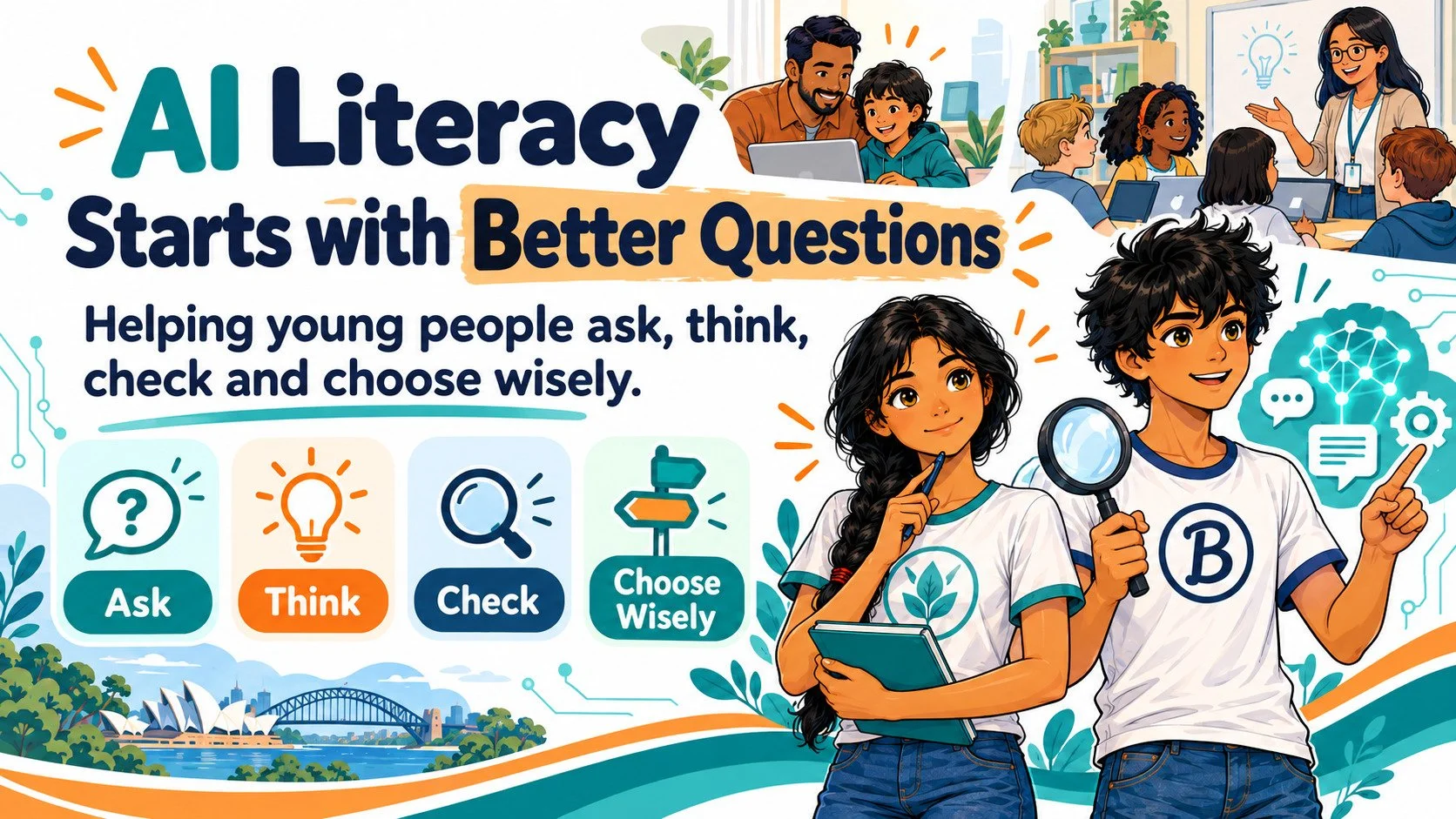
AI and Our Children: Less Fear, Better Questions.
For parents of tweens and young teens, the useful question is no longer whether AI is coming. It is what we teach our children to do with it. I think we need to admit how much we still don't know about children and artificial intelligence. Generative AI has arrived faster than the research needed to understand its long-term effects. We don't yet have twenty-year studies following children who began using conversational AI at eleven. We don't know enough about dependence, intellectual confidence, creativity, attention, relationships or what happens when a child grows accustomed to having a machine available whenever thinking becomes uncomfortable.
Some of the concern parents are feeling is therefore justified. But there is something else going on too. Fear sells. That is not simply a cynical swipe at journalism. Researchers tested more than 100,000 versions of online news stories, generating around 370 million impressions, and found that negative words in headlines increased the likelihood that people would click. An additional negative word in an average-length headline lifted the click-through rate by about 2.3 per cent (Robertson et al., 2023).
So we have a difficult mix: legitimate unanswered questions about children and AI, alongside a media economy that knows alarming stories get attention. Parents are left in the middle of it. One week AI is going to destroy children's ability to think. The next it is going to give every child a personal tutor. Somewhere between those two headlines, families still have homework to do on Tuesday night.
That is where I want to stay with this article.
Can we get enough clarity from the research we do have to use AI for education without pretending the risks aren't there? I think we can. But I have become increasingly convinced that the important divide isn't between children who use AI and children who don't. It is between children who learn to use AI without surrendering the parts of learning they still need to do themselves, and children who gradually hand those parts over. That takes education. It also takes character. And it probably needs to start earlier than many of us expected.
An old reading tutor changed the way I looked at this. I went looking for evidence behind a claim I had heard several times: that AI can teach a child to read almost as successfully as a human tutor. That claim, stated that broadly, is too strong. What I found was actually more interesting. Back in 2003, long before ChatGPT, researchers studied 131 children in Years 2 and 3. Fifty-eight used an automated Reading Tutor that listened while they read aloud and offered spoken and graphical help. Thirty-four received individual tutoring from qualified teachers using the same stories. Another 39 continued with normal classroom instruction.
Human tutors produced significantly greater gains on one measure of phonics-based decoding, known as ‘Word Attack’, which tests how well children can sound out unfamiliar words. Across several other reading measures, however, the differences between children using the automated tutor and those receiving human tutoring were not statistically significant (Mostow et al., 2003).
I would be very reluctant to turn that finding into "computers teach reading as well as teachers". They don't. A reading teacher sees hesitation, frustration, humour, confidence, family circumstances and a hundred other things a tutoring system doesn't understand. But the study demonstrated something that matters enormously if we care about educational access.
Some elements of individual tutoring can be automated surprisingly well.
A later meta-analysis examined 107 effect sizes involving more than 14,000 learners. Intelligent tutoring systems produced better achievement than large-group teacher instruction, conventional computer instruction and textbook or workbook learning. Across the studies included, the researchers found no statistically significant difference between intelligent tutoring systems and individual human tutoring, although the contexts and systems varied considerably (Ma et al., 2014).
That does not give us permission to replace teachers. It gives us another possibility. A teacher with thirty students cannot sit beside every child for twenty minutes while that child practises fractions, reads aloud, revises vocabulary or works through a misunderstanding. A parent may want to help at home but may not know how to explain algebra, chemistry or sentence structure. A well-designed AI tutor can sometimes fill a piece of that gap. At enormous scale. That interests me far more than asking AI to write an essay. Then I came across a study that made the danger much clearer.
Nearly 1,000 high-school mathematics students took part in a large experiment published in Proceedings of the National Academy of Sciences. Some students worked without AI. Some had access to GPT-4 in a fairly unrestricted form. Others used a specially designed GPT tutor. That tutoring version had been instructed not to give away complete answers. It knew the teacher's solutions, anticipated common mistakes and tried to offer hints instead (Bastani et al., 2025). While students had access to AI, their performance shot up. Students using unrestricted GPT performed about 48 per cent better on the practice problems than students without AI. Those using the safeguarded tutor did even better during practice.
Then the researchers took the AI away. Students who had been using unrestricted GPT subsequently performed 17 per cent worse than the students who had practised without it. The apparent improvement had hidden something. Many students had become very good at completing mathematics problems with GPT. They had not necessarily become better at mathematics. The researchers could see some of the reason in the conversation logs. Students with unrestricted access were more likely to ask for answers and copy solutions. Students using the tutoring version were more likely to attempt problems themselves and ask for help when they became stuck (Bastani et al., 2025).
For parents, I think this is one of the most useful findings we have. Watch what the child is outsourcing.
If your thirteen-year-old asks AI, "Give me the answer to question four", very little learning may be taking place.
If she says, "I've tried question four and this is where I got stuck. Don't solve it for me. Give me one hint", we have a very different activity.
The computer hasn't changed. The intellectual behaviour has.
A 2025 randomised controlled trial in a Harvard physics course adds another part to the picture. Students using a carefully constructed AI tutor learned more than students in an active-learning classroom condition, spent less time on the activity and reported greater engagement and motivation (Kestin et al., 2025). These were university students, so I wouldn't automatically apply the result to twelve-year-olds. Still, the AI tutor had been deliberately built around established teaching methods, including scaffolding, active learning, feedback and self-pacing. It wasn't simply ChatGPT with the door left open (Kestin et al., 2025).
A systematic review and meta-analysis of experimental ChatGPT studies has also found positive effects on academic performance and higher-order thinking, while finding reductions in mental effort. That last finding is worth sitting with. Reduced mental effort can mean unnecessary cognitive load has been removed. It can also mean the technology is doing work the learner ought to be doing. Context matters (Deng et al., 2025).
That seems to be where the educational conversation becomes much more useful. The question isn't simply, "Did AI make the task easier?" Sometimes that is exactly what we want. The better question is, "What became easier, and should it have?" The child still needs to develop a person behind the prompt.
There is a point where AI literacy runs into something older than technology.
Character.
Suppose two thirteen-year-olds know exactly the same things about AI. They understand hallucinations. They know not to enter private information. They can prompt well. They understand that AI-generated material may contain bias or error. One uses it to generate three practice questions before a test. The other gets it to write the assignment due tomorrow morning. Their technical knowledge may be identical. The difference lies somewhere else.
Self-control matters when a shortcut is available.
Honesty matters when cheating becomes difficult to detect.
Perseverance matters when a difficult problem can disappear after six words typed into a chatbot.
Responsibility matters when a machine confidently supplies an answer and the child has to decide whether to believe it.
Character education has a research base of its own. A meta-analysis of 214 studies involving more than 307,000 participants found a small but significant positive overall effect from character education programs. The estimated effect became smaller when researchers adjusted for publication bias, but remained positive (Brown et al., 2023).
The neighbouring field of social and emotional learning has an even larger evidence base. A 2023 meta-analysis examined 424 studies across 53 countries, involving more than 575,000 students. School-based social and emotional learning programmes were associated with improvements in skills, behaviour, peer relationships, school functioning and academic achievement, although effects varied according to programme design and implementation (Cipriano et al., 2023).
I don't think children need a new subject called "Being Good While Using ChatGPT". But I do think AI makes several old virtues newly practical. A child who has never had to think about intellectual honesty now carries a machine capable of producing plausible schoolwork in seconds.
We need to talk about that.
AI literacy should begin before children are left alone with AI. It is sometimes treated as if it means knowing how to prompt. That is the shallow end of it. A large systematic review of K-12 AI literacy research found that the field includes understanding AI concepts and how systems work, but also the capacity to think critically about how AI affects people's lives. The authors argued for coherent, age-appropriate progression through schooling rather than a collection of unrelated technology activities (Casal-Otero et al., 2023).
Recent classroom research gives us a glimpse of what that can look like. In a Year 10 English classroom, Tang and colleagues examined how students learned to question AI-generated information. Their work suggests that productive AI use depended heavily on instructional design, the role of the teacher, students' existing knowledge and their willingness to probe the AI rather than simply consume what it produced (Tang et al., 2026).
I would start those habits well before Year 10.
At home, an eleven-year-old can already learn to ask:
"How do we know that's true?"
"Where could we check it?"
"Why might the AI be wrong?"
"Am I learning this, or am I getting the machine to avoid learning it?"
Those aren't computer-science questions. They are judgement questions. Digital citizenship adds another layer: privacy, attribution, respect, academic honesty, wellbeing and an understanding that digital actions still have human consequences. This is why I don't think AI literacy should suddenly appear in senior secondary school, just before students leave for university or work. By then, the habits may already be well established.
There is a difference
There are some uses I would be much more wary of. Educational tutoring is one thing. A twelve-year-old forming an emotionally dependent relationship with a chatbot is another. We should resist lumping them together simply because both happen to involve AI.
A preregistered study of 1,599 Danish high-school students found that 14.6 per cent reported some form of friend-like conversation with chatbots. Most of those conversations were practical rather than genuinely relational. A much smaller group, 2.44 per cent of the whole sample, engaged with chatbots for social support or more reciprocal forms of conversation. Those adolescents reported greater loneliness and lower perceived social support than their peers (Herbener & Damholdt, 2025).
We need to be precise here. It was a cross-sectional study. It cannot tell us that chatbots caused those young people to become lonely. It is entirely plausible that adolescents who already felt isolated were more likely to seek support from a chatbot.
Either way, I would want to know if my child was turning to a machine for companionship.
A 2026 review of 80 studies on chatbot use and adolescent mental health found evidence of possible benefits in some therapeutic settings, but also raised unresolved concerns about dependency, social withdrawal, privacy and long-term developmental effects (Wu et al., 2026).
This is one area where "AI" is too broad a word to be useful.
An algebra tutor that refuses to give the final answer and an anthropomorphic chatbot designed to keep a lonely thirteen-year-old talking are not the same proposition for a parent.
I would judge them differently. I therefor don't support a blanket AI ban. There are circumstances where I would restrict it without hesitation.
If a teacher is trying to find out whether a student can write an argument independently, AI shouldn't write the argument.
If the purpose of homework is to practise arithmetic fluency, an AI solving the calculations has defeated the exercise.
If a product is inappropriate for a child's age, exploits personal data or deliberately encourages emotional attachment, keeping children away from it is sensible.
A ban on particular uses can therefore be completely compatible with AI literacy. What troubles me is the idea that keeping children away from AI altogether somehow prepares them for living with it.
We already have evidence that intelligent tutoring can support learning at scale (Ma et al., 2014). Carefully designed generative AI tutoring can improve learning under some conditions (Kestin et al., 2025). AI-generated feedback, across 41 studies involving 4,813 students, produced no statistically significant overall difference in learning performance compared with human feedback, although the variation between studies was substantial and the evidence was concentrated heavily in language and writing contexts (Kaliisa et al., 2026).
That last detail is significant. "AI feedback is as good as human feedback" would be an attractive headline. It would also be an unjust interpretation of the study. The researchers themselves warn against interpreting a non-significant difference as proof of equivalence. Human feedback carries relational, contextual, ethical and mentoring qualities that these studies have barely measured (Kaliisa et al., 2026).
This is where I think the sensible position sits.
Use machines for the things they can genuinely help with. Keep humans responsible for the things that require human responsibility. Parents shouldn't have to work this out separately from schools.
This may be the part of the AI-in-education debate we are neglecting.
A child can receive one set of rules at school and a completely different message at home.
The teacher says AI can be used to brainstorm but not draft.
Dad says, "Why wouldn't you use it? It saves time."
Mum is convinced all AI use is cheating.
The student discovers that everyone in the class is quietly using it anyway.
That is hardly a recipe for digital citizenship.
We need parents and schools speaking a more consistent language.
There is good evidence outside AI education that family-school cooperation matters. A meta-analysis of 77 family-school partnership interventions found positive effects on children's academic and social-emotional outcomes (Smith et al., 2020). A related meta-analysis found that communication, collaboration and the quality of parent-teacher relationships were among the elements associated with stronger social and behavioural outcomes (Sheridan et al., 2019).
And there is an interesting lesson specifically for the middle-school years.
Hill and Tyson's meta-analysis found that, during the middle-school years, the most helpful parental involvement was not closely supervising homework or sitting beside a child while they completed assignments. What mattered more was what the researchers called academic socialisation: parents talking with their children about why learning matters, what they are trying to achieve, how to approach difficult work, which study strategies might help, and how school connects with future goals. In other words, parents were most helpful when they guided their child's thinking and expectations rather than taking over the work itself. Direct involvement in homework showed a weaker and less consistently positive relationship with achievement (Hill & Tyson, 2009).
That strikes me as particularly relevant to AI. Parents don't need to hover behind a thirteen-year-old inspecting every prompt. They do need to have conversations about what the child thinks AI is for.
💡 Schools could help enormously here. Every school introducing AI should, in my view, offer a simple parent and caregiver learning programme alongside whatever students are being taught.
Show families how the approved tools work.
Explain where AI gets things wrong.
Demonstrate the difference between asking for an answer and asking for a hint.
Agree on what information should never be shared.
Explain when AI use must be acknowledged.
Talk openly about cheating, dependency and emotionally persuasive chatbots.
Most importantly, let parents see examples of good AI-supported learning.
A family could sit down together with a difficult science idea. The child explains what she currently understands. AI offers another explanation. Parent and child compare that answer with the textbook or a reliable source. Then the child closes the AI and explains the idea again in her own words.
That is AI literacy.
It is also family learning.
And there is still a child doing the thinking.
Perhaps that is the test. I've become less interested in asking whether AI is "good for children". That category is way too broad. A calculator can support mathematics or prevent a child learning arithmetic. You need to know the task, the age and the purpose before the question makes much sense. AI is like that, only vastly more capable.
Before allowing an AI activity, I would ask one practical question:
What do I want the child to be able to do afterwards without the AI?
If I want her to understand fractions, the AI should help her understand fractions.
If I want him to become a better writer, the AI should help him notice weaknesses in his own writing rather than quietly replace it.
If I want a child to learn how misinformation works, AI can generate material to investigate. The child still needs to decide what can be trusted and why.
If the student can only perform the task while the machine is present, we may have improved today's output without improving the learner.
Bastani and colleagues' mathematics study makes that uncomfortable possibility very hard to ignore (Bastani et al., 2025). This is also why character belongs in the discussion. We can teach children how large language models work, how to verify information, how to protect their privacy and how to disclose AI assistance. Sooner or later, though, the child sits alone in front of the screen.
No parent.
No teacher.
Assignment due tomorrow.
The AI offers to make the difficult part disappear. What happens next is partly an AI-literacy question. It is also a character question. That is where I think families and schools have work to do together. Not because children need to fear AI.
they need enough knowledge to understand it,
enough practice to use it well, and
enough judgement to know when they should do the hard part themselves.
The machine is going to keep getting better. Our job is to make sure the child does too.
References
Bastani, H., Bastani, O., Sungu, A., Ge, H., Kabakcı, Ö., & Mariman, R. (2025). Generative AI without guardrails can harm learning: Evidence from high school mathematics. Proceedings of the National Academy of Sciences, 122(26), e2422633122. https://doi.org/10.1073/pnas.2422633122
Brown, M., McGrath, R. E., Bier, M. C., Johnson, K., & Berkowitz, M. W. (2023). A comprehensive meta-analysis of character education programs. Journal of Moral Education, 52(2), 119–138. https://doi.org/10.1080/03057240.2022.2060196
Casal-Otero, L., Catala, A., Fernández-Morante, C., Taboada, M., Cebreiro, B., & Barro, S. (2023). AI literacy in K-12: A systematic literature review. International Journal of STEM Education, 10, 29. https://doi.org/10.1186/s40594-023-00418-7
Cipriano, C., Strambler, M. J., Naples, L. H., Ha, C., Kirk, M., Wood, M., Sehgal, K., Zieher, A. K., Eveleigh, A., McCarthy, M., Funaro, M., Ponnock, A., Chow, J. C., & Durlak, J. (2023). The state of evidence for social and emotional learning: A contemporary meta-analysis of universal school-based SEL interventions. Child Development, 94(5), 1181–1204. https://doi.org/10.1111/cdev.13968
Deng, R., Jiang, M., Yu, X., Lu, Y., & Liu, S. (2025). Does ChatGPT enhance student learning? A systematic review and meta-analysis of experimental studies. Computers & Education, 227, 105224. https://doi.org/10.1016/j.compedu.2024.105224
Herbener, A. B., & Damholdt, M. F. (2025). Are lonely youngsters turning to chatbots for companionship? The relationship between chatbot usage and social connectedness in Danish high-school students. International Journal of Human-Computer Studies, 196, 103409. https://doi.org/10.1016/j.ijhcs.2024.103409
Hill, N. E., & Tyson, D. F. (2009). Parental involvement in middle school: A meta-analytic assessment of the strategies that promote achievement. Developmental Psychology, 45(3), 740–763. https://doi.org/10.1037/a0015362
Kaliisa, R., Misiejuk, K., López-Pernas, S., & Saqr, M. (2026). How does artificial intelligence compare to human feedback? A meta-analysis of performance, feedback perception, and learning dispositions. Educational Psychology, 46(1), 80–111. https://doi.org/10.1080/01443410.2025.2553639
Kestin, G., Miller, K., Klales, A., Milbourne, T. W., & Ponti, G. (2025). AI tutoring outperforms in-class active learning: An RCT introducing a novel research-based design in an authentic educational setting. Scientific Reports, 15, 17458. https://doi.org/10.1038/s41598-025-97652-6
Ma, W., Adesope, O. O., Nesbit, J. C., & Liu, Q. (2014). Intelligent tutoring systems and learning outcomes: A meta-analysis. Journal of Educational Psychology, 106(4), 901–918. https://doi.org/10.1037/a0037123
Mostow, J., Aist, G., Burkhead, P., Corbett, A., Cuneo, A., Eitelman, S., Huang, C., Junker, B., Sklar, M. B., & Tobin, B. (2003). Evaluation of an automated Reading Tutor that listens: Comparison to human tutoring and classroom instruction. Journal of Educational Computing Research, 29(1), 61–117. https://doi.org/10.2190/06AX-QW99-EQ5G-RDCF
Robertson, C. E., Pröllochs, N., Schwarzenegger, K., Pärnamets, P., Van Bavel, J. J., & Feuerriegel, S. (2023). Negativity drives online news consumption. Nature Human Behaviour, 7, 812–822. https://doi.org/10.1038/s41562-023-01538-4
Sheridan, S. M., Smith, T. E., Kim, E. M., Beretvas, S. N., & Park, S. (2019). A meta-analysis of family-school interventions and children's social-emotional functioning: Moderators and components of efficacy. Review of Educational Research, 89(2), 296–332. https://doi.org/10.3102/0034654318825437
Smith, T. E., Sheridan, S. M., Kim, E. M., Park, S., & Beretvas, S. N. (2020). The effects of family-school partnership interventions on academic and social-emotional functioning: A meta-analysis exploring what works for whom. Educational Psychology Review, 32(2), 511–544. https://doi.org/10.1007/s10648-019-09509-w
Tang, K.-S., Cooper, G., Rappa, N., & Edwards, J. (2026). Critical questioning with generative AI: Developing AI literacy in secondary education. Thinking Skills and Creativity, 59, 102043. https://doi.org/10.1016/j.tsc.2025.102043
Wu, Y., Wu, T., Zhu, K., Liu, X., Liu, J., Wang, Y., Shi, R., Xiong, J., Xing, X., Lv, Y., Niu, Y., Peng, M., & Du, X. (2026). The impact of chatbots on adolescent mental health development: A comprehensive literature review. Journal of Multidisciplinary Healthcare, 19, 579872. https://doi.org/10.2147/JMDH.S579872