We Tell Children Not to Misuse AI. So Why Aren't We Teaching Them How to Use It?
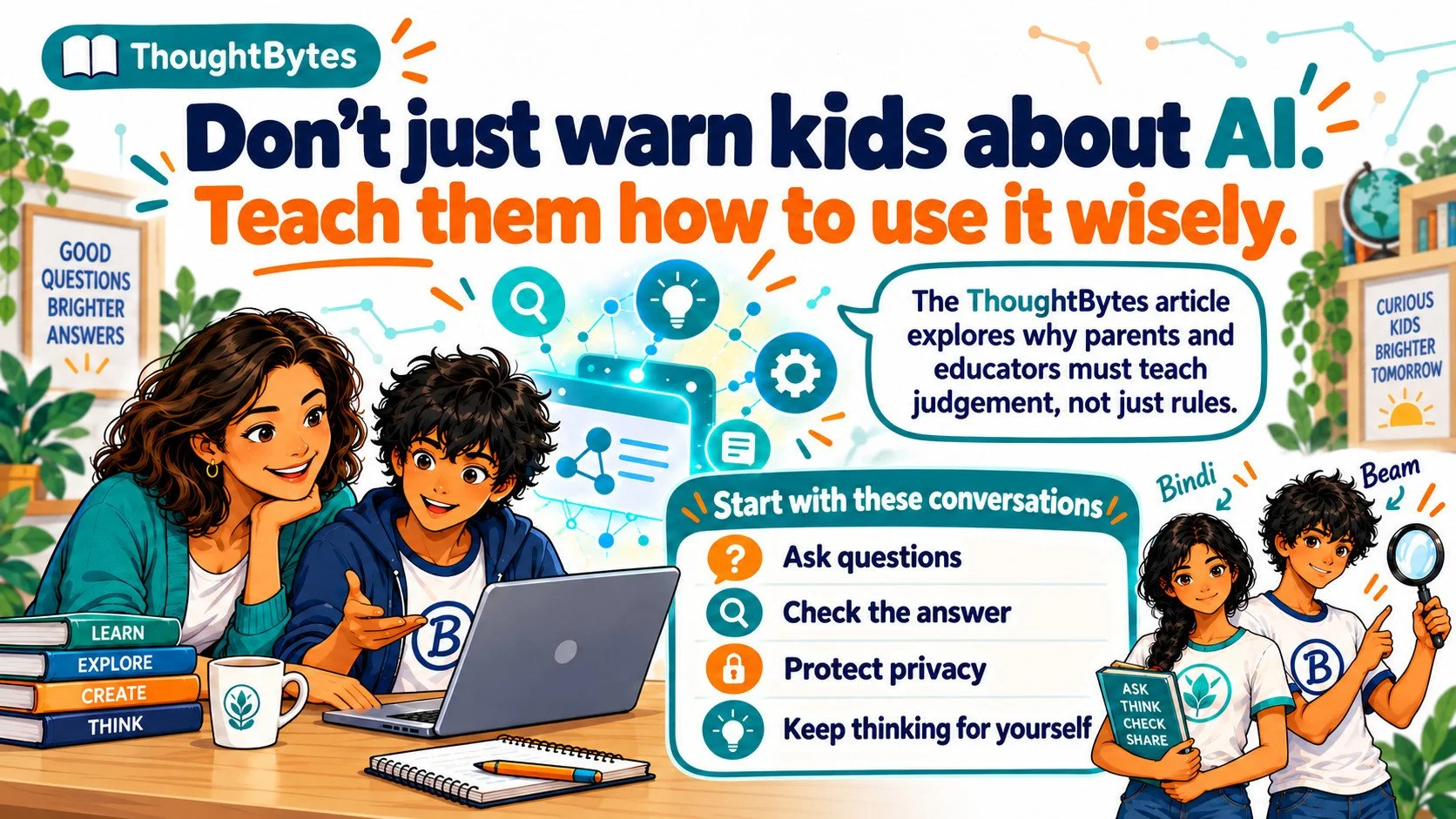
The frustration of one student reveals a growing gap in AI education, and why parents need to be part of the solution.
In 2024, a student was accused of using artificial intelligence to complete an assignment. The student insisted they hadn't, and their explanation was convincing. Being wrongly accused of cheating would upset most students, particularly when the accusation concerns something as difficult to establish as AI-generated writing. Yet what bothered this student most was something else entirely. Nobody was teaching them about AI. They were expected to follow rules about a technology that adults were already using in their workplaces, universities and everyday lives. Teachers were experimenting with it. Businesses were embracing it. AI was appearing in search engines, creative software and countless other applications. Yet students were being warned about its misuse without necessarily being shown how it worked or when its use might be appropriate.
I can understand that frustration. After ten years teaching secondary school students, I know how quickly young people notice inconsistencies in the rules adults make for them. They are particularly good at spotting the gap between what we tell them to do and what we do ourselves. And in this case, I think the student had a point. We have spent considerable energy worrying about whether children are using AI to cheat. I wonder whether we have devoted enough attention to teaching them how to use it intelligently.
The problem with teaching through prohibition
Schools have legitimate reasons to restrict AI use in certain circumstances. Students need opportunities to develop their own writing, reasoning and problem-solving abilities. If an AI system completes every difficult task, the student may produce acceptable work without acquiring the knowledge or skills the assignment was intended to develop. There are also questions about privacy, reliability and academic honesty that schools cannot ignore. But telling students not to use AI does little to explain why it might be inappropriate for one task and genuinely useful for another.
Consider a student struggling to understand photosynthesis. They could ask an AI chatbot to explain the process in simpler language, then check that explanation against their textbook. That seems a reasonable learning activity, provided the student is encouraged to question the response. Now imagine the same student asking the chatbot to complete their science assignment and submitting the answer as their own work. The technology hasn't changed. The student's purpose has.
Young people need to understand that distinction, preferably before they encounter the temptation to take a shortcut. Research has been pointing in this direction for some time. In a systematic review of AI literacy in K–12 education, Casal-Otero and colleagues (2023) examined how schools were introducing artificial intelligence and what students needed to learn. Their findings describe AI literacy as a field involving technical understanding alongside ethical and social considerations.
A separate review by Lee and Kwon (2024) examined AI education in K–12 classrooms, including the teaching approaches used and the learning outcomes reported.
Neither review offers a simple recipe for teaching AI. They do, however, provide a useful foundation for treating AI literacy as an educational responsibility rather than merely a matter of enforcing school rules. I would go further. If schools expect students to exercise judgement about AI, then developing that judgement should be an explicit part of their education.
Being able to use AI doesn't mean understanding it
I suspect many parents underestimate how easily children can become confident AI users without developing much understanding of the technology. A young teenager can produce an impressive image, summarise a chapter or generate a convincing essay within seconds. They may become quite skilled at obtaining the responses they want. But fluency with a chatbot tells us very little about whether that child understands what happens behind the screen.
Does the student know that a language model can generate plausible information that is factually incorrect? Can they recognise when a response contains invented references? Do they understand that entering personal information into an AI service may have privacy consequences?
There is also a less obvious concern. A child may become so accustomed to receiving immediate answers that they begin avoiding the uncomfortable work of figuring things out. That discomfort is familiar to anyone who has taught mathematics or science. Students struggle with a problem. They try an approach that doesn't work. They return to an earlier idea, ask a question, perhaps make another mistake. Eventually, something clicks. The answer matters, of course, but so does the intellectual work involved in reaching it. AI can help with that process. It can offer another explanation, provide examples or suggest a different way of approaching a problem. It can also remove much of the thinking if the student allows it to. The educational question is how children learn to recognise the difference.
A systematic review by Liu and Zhong (2024), examining research into K–12 AI education, discusses the importance of teaching approaches and learning activities suited to students' development. Their work reinforces the need for more than occasional exposure to AI tools. I believe children should encounter AI education through ordinary problems they recognise. A suspicious photograph, an unreliable answer, a homework dilemma or an AI-generated story can all become opportunities to practise judgement. The technology becomes something to investigate rather than simply consume.
What about the parents?
This is where I think the conversation about AI literacy has been too heavily focused on schools.A child doesn't stop encountering artificial intelligence when the school day ends. They may use a chatbot to help with homework, ask it for personal advice, generate images or encounter AI-produced content through social media. Recommendation systems are already shaping much of what young people see online, even when they don't recognise those systems as applications of AI. Parents are therefore being drawn into decisions about technology that many have had little opportunity to understand themselves.
We are asking parents to supervise something that is changing faster than most families can reasonably keep up with. Even those who work with technology can find themselves surprised by what new systems can do. Some parents respond by restricting access. Others allow their children to experiment, trusting that familiarity will eventually produce competence. Neither approach guarantees understanding.
Research into parental mediation offers a useful perspective. A 2025 study involving 853 adolescents examined associations between parental mediation, AI literacy and young people's attitudes towards AI. It reported a positive relationship between active parental mediation and adolescents' AI literacy, while restrictive mediation did not show a significant association with AI literacy.
The study, Parental Mediation and Adolescent's AI Literacy: Effects on AI Trust, Creepiness, and Intention to Use (2025), is observational, so its findings should not be interpreted as proof that parental conversations directly cause improved AI literacy. Nevertheless, the distinction between active guidance and restriction is worth considering.Active mediation means taking an interest in what children are doing, discussing their experiences and helping them evaluate what they encounter.
For example, a parent might sit beside their child while they ask a chatbot to explain a historical event. Instead of accepting the response, they could choose one factual claim and check it against another source. Perhaps the chatbot is correct. Perhaps it has confused two events or supplied an incorrect date. Either outcome creates an opportunity to learn something. The parent doesn't need to understand the mathematics behind a large language model. They simply need to be willing to question the information it produces. I would much rather see a family occasionally investigate an AI answer together than have a child become an expert at using the technology without ever learning to doubt it.
The uncomfortable question of adult behaviour
I want to return to the student's complaint about adults having different rules. It deserves more attention than it usually receives. We cannot expect children to develop responsible habits if the adults around them demonstrate little restraint or curiosity about their own technology use.
A parent who routinely forwards unverified information, accepts the first AI-generated answer or allows a recommendation algorithm to determine what they watch all evening is hardly demonstrating critical digital judgement. Teachers face a similar difficulty. If students see educators using AI to prepare lessons, develop resources or summarise material, they will reasonably want to know why their own use is restricted.
There are good educational reasons for different expectations. A teacher preparing a worksheet and a student demonstrating their understanding are performing different tasks. But those reasons need explaining. Children are capable of understanding that learning a skill sometimes requires doing something the difficult way. We don't allow a calculator to replace every stage of learning arithmetic, even though calculators are useful and widely available.
AI deserves a similarly considered approach, although the questions are often more complicated. An AI system can do considerably more than calculate an answer. It can produce the explanation, write the argument and imitate the student's preferred style. That makes it particularly important to establish which parts of a learning task students should complete themselves. I would also like to see adults become more comfortable acknowledging their own uncertainty. There is nothing wrong with a parent telling their child, "I'm not sure whether that AI answer is correct. Let's check." In fact, I think that is a valuable lesson in itself.
Why I developed AI-Ready Kids for Parents
My work as a science educator and an author of adventure fiction for young readers has increasingly focused on a question that troubles me: how do we prepare children for digital technologies that are deliberately designed to be easy, appealing and, in some cases, difficult to disengage from? With social media and gaming, we have already seen the consequences of introducing powerful digital systems into children's lives before providing adequate education about their influence. I don't want us to repeat that mistake with artificial intelligence. This concern helped shape my AI-Ready Kids course for Parents.
The 16-week short lesson course is intended to give parents a practical starting point for understanding AI and discussing it with their children, particularly during the middle-school years when young people are becoming more independent in their digital lives. I am interested in the everyday decisions families face.
Should a child use AI to help with homework?
How can parents explain the difference between assistance and cheating?
What should children know about sharing personal information?
How can they learn to recognise an unreliable answer?
How do we protect the habit of independent thinking when obtaining a ready-made answer has become so effortless?
These questions also connect with character education, which I believe deserves a much more prominent place in discussions about AI literacy. A child might understand perfectly well that submitting an AI-generated assignment as their own work is dishonest. Whether they resist that temptation depends on more than technical knowledge. It involves integrity, self-control and a willingness to take responsibility for their choices. Similarly, knowing that AI can generate misleading content is one thing. Deciding not to share an entertaining but unverified story requires judgement and consideration for others.
These qualities develop through experience and discussion. Parents have opportunities to encourage them in ordinary family life, often without needing a screen at all. The course is my attempt to make those conversations easier to begin.
What the research tells us, and what it doesn't
I think we need to be careful about promising too much from AI education. Artificial intelligence is developing quickly, while research into its long-term effects on children's learning and behaviour is still catching up. A systematic review can identify promising teaching practices and recurring findings. It cannot tell us exactly how today's eleven-year-olds will be affected by years of routine interaction with increasingly capable AI assistants. Nor should we assume that a short course will solve the difficulties families face. There is, however, a growing body of work supporting the value of structured AI education.
Casal-Otero et al. (2023), Lee and Kwon (2024), and Liu and Zhong (2024) each examine aspects of how AI is being taught in schools. Their reviews identify the need to develop knowledge and skills while attending to ethical questions and the way students learn. UNESCO's AI Competency Framework for Students (Miao & Shiohira, 2024) provides additional guidance. It includes a human-centred approach, ethics, AI techniques and applications, and AI system design. The UNESCO framework is an educational policy resource rather than a peer-reviewed experimental study, but it offers a useful reference for schools developing their approach to AI literacy. What interests me most is the recognition that children need opportunities to understand and evaluate AI, not merely operate it.
For parents, that might begin with something as modest as checking an AI-generated answer together or discussing why a chatbot should not be treated as a confidential friend. Those are manageable conversations. They don't require expensive equipment, technical qualifications or hours of additional homework. They require adult involvement.
I keep thinking about that student
The student accused of using AI in 2024 raised a complaint that still seems remarkably relevant two years later. We have introduced a technology capable of completing work that students are expected to do themselves. We have begun writing rules to control its use, yet the educational response remains uneven. There is an additional irony in that original accusation.
AI-detection tools themselves can make mistakes. A confident prediction that a passage was generated by AI is not proof of misconduct. Students deserve fair assessment procedures, including an opportunity to explain their work and show how it developed. If we expect young people to question AI-generated information, adults should be equally willing to question the judgements made by AI-detection systems. I wonder what that student would say today.
Would they feel better informed about AI?
Would they understand why it is appropriate for some learning activities but not others?
Would they know how to protect their information or recognise when a convincing answer is unreliable?
Would they still be expected to work it out for themselves?
As an educator, I find the possibility of that last answer difficult to accept. We teach children how to cross roads safely before expecting them to manage traffic independently. We teach them to read critically because we know that printed information can be wrong, misleading or deliberately persuasive. Artificial intelligence deserves the same educational attention.
I would like parents to feel confident enough to explore it alongside their children, and for schools to give students clearer explanations of what responsible AI use actually looks like.
That is the thinking behind AI-Ready Kids. And it begins with taking the student's original complaint seriously.
If we expect children to use AI responsibly, we have to make time to teach them how.
References and further reading
Casal-Otero, L., Catala, A., Fernández-Morante, C., Taboada, M., Cebreiro, B., & Barro, S. (2023). AI literacy in K–12: A systematic literature review. International Journal of STEM Education, 10, Article 29. https://doi.org/10.1186/s40594-023-00418-7
Lee, S. J., & Kwon, K. (2024). A systematic review of AI education in K–12 classrooms from 2018 to 2023: Topics, strategies, and learning outcomes. Computers and Education: Artificial Intelligence, 6, 100211. https://doi.org/10.1016/j.caeai.2024.100211
Liu, X., & Zhong, B. (2024). A systematic review on how educators teach AI in K–12 education. Educational Research Review, 45, 100642.
Miao, F., & Shiohira, K. (2024). AI competency framework for students. UNESCO. https://www.unesco.org/en/articles/ai-competency-framework-students
Parental Mediation and Adolescent's AI Literacy: Effects on AI Trust, Creepiness, and Intention to Use. (2025). International Journal of Human–Computer Interaction. https://doi.org/10.1080/10447318.2025.2580549
About the author
Casper Pieters is a science educator, former science television producer and author of Bindi & Beam and Team Savv-i, adventure stories that introduce young readers to digital citizenship, persuasive technology and artificial intelligence. Through his Edufiction learning resources and AI-Ready Kids initiative, he helps families and educators explore the digital world through storytelling, discussion and practical activities.
Learn more: www.casperpieters.com