THURSDAY — SMALL ACT #4: DON’T GIVE CRUELTY AN AUDIENCE
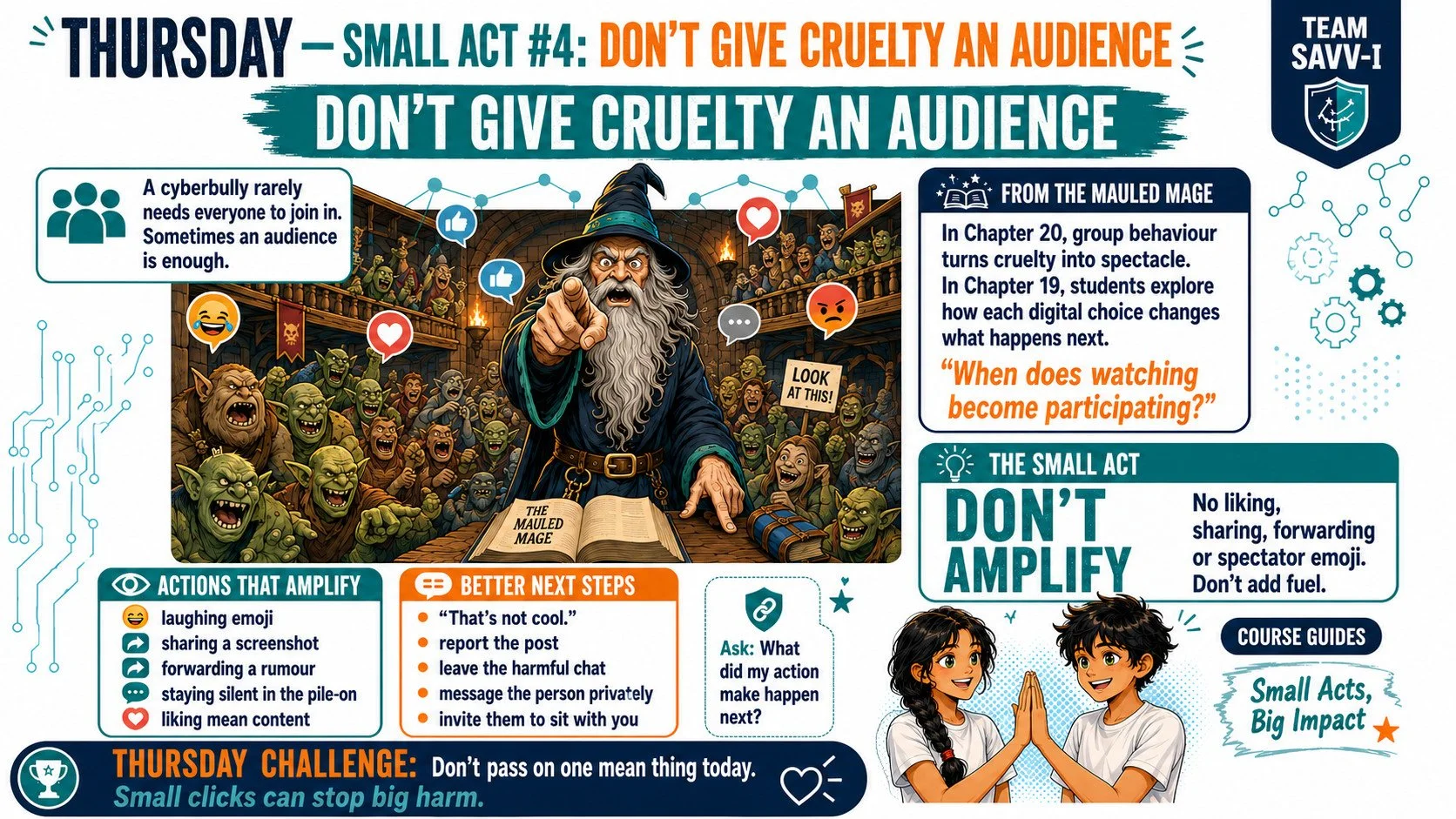
A cyberbully rarely needs everyone to join in. Sometimes an audience is enough.
There is a useful word in discussions about cyberbullying that children understand almost immediately once you show them what it means: amplify.
One nasty comment is written.
Someone reacts with a laughing emoji.
Another person screenshots it.
Someone sends it to a different group.
Three people like it.
Nobody challenges it.
By lunchtime the original cruelty has acquired an audience.
The children who passed it on may protest that they never wrote the comment.
That is precisely where Thursday’s conversation should begin.
In the Mauled Mage Activity Guide, Chapter 19: The Castle explores how apparent group support can make a bully seem more powerful. The accompanying Cyber Support Chain gives students cards representing actions such as liking a post, sharing a rumour, ignoring a harmful comment and reporting content. They then examine how each choice affects what happens next.
I like this activity because it turns a rather vague instruction such as be responsible online into something a child can hold in their hand.
LIKE
SHARE
IGNORE
REPORT
Put one card on the table and the direction of the story changes.
Put down another and it changes again.
That is Small Acts, Big Impact in miniature.
The Mauled Mage Read-Aloud Kit offers another striking way into the same conversation. Chapter 20: The Feast is deliberately uncomfortable. Group behaviour begins turning cruelty into spectacle. It is fantasy, exaggerated enough to be memorable, but the social mechanism will be familiar to many children.
After reading it, I would ask a class a deceptively difficult question: When does watching become participating?
There probably won't be one clean answer.
Good.
Let them argue.
Does laughing count?
What about staying in the group chat and saying nothing?
What about forwarding a screenshot to your best friend “just so you can see what happened”?
What if you disagree privately but click the laughing emoji because everyone else has?
What if you leave?
What if you message the targeted person afterwards?
What if you report the post?
Children need somewhere to examine these grey areas before encountering them at eleven o’clock at night with a phone in their hand. Bullying No Way advises students not to encourage harmful behaviour by laughing, liking or sharing mean content and suggests showing disapproval, offering support and reporting when needed. (Bullying No Way)
That makes Thursday's school challenge particularly easy to remember:
Don't add fuel.
No forwarding for entertainment.
No pile-on.
No spectator emoji.
No “I was only joking” share.
And when it is safe, replace the audience with something better.
A private message: I saw what happened. Are you okay?
A public response: That's not cool.
A report.
An invitation to come and sit somewhere else.
One click helped spread it.
Another small action can interrupt it.
There is an appealing symmetry in that for young learners. Digital citizenship stops sounding like a set of adult rules about devices and becomes a question of agency: What did my action make happen next? The The Mauled Mage learning system repeatedly brings students back to choices and consequences. That is where story earns its place in this conversation. Students are not merely learning the definition of cyberbullying. They watch behaviour gather momentum around characters they know and then get the chance to change the chain themselves.
Thursday’s small act: DON’T AMPLIFY.
#BullyingNoWay #SmallActsBigImpact #DontAmplify #Cyberbullying #TheMauledMage #BeKindOnline #DigitalCitizenship #OnlineSafety #UpstanderAction #ThoughtBytes #BullyingNoWayWeek #SmallActsBigImpact #BullyingNoWay #LetsStopBullying #NationalDayOfAction or #NDA2026