WEDNESDAY — SMALL ACT #3: SAY SOMETHING TO SOMEONE WHO CAN HELP
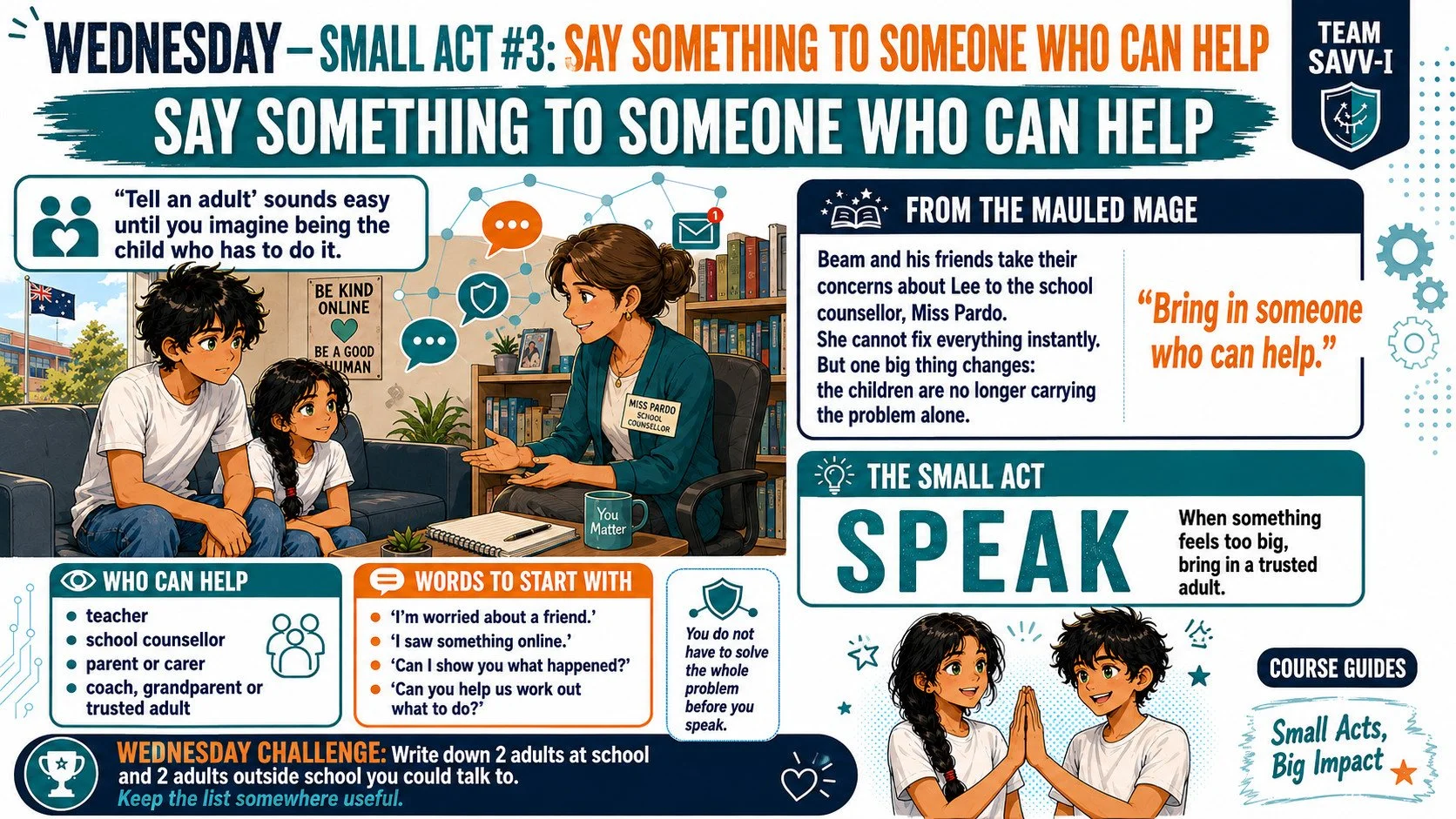
“Tell an adult” sounds easy until you imagine being the child who has to do it
One of the problems with teaching children about bullying is that adults sometimes make courage sound terribly straightforward.
See something wrong.
Speak up.
Tell somebody.
Problem solved.
Except children know school life is rarely that tidy.
What if you are wrong?
What if the person being bullied asks you not to tell?
What if everybody finds out you reported it?
What if the bully is popular?
What if telling makes things worse?
Those questions deserve better than another poster.
They deserve rehearsal.
In The Mauled Mage, Beam and his friends eventually take their concerns about Lee to the school counsellor, Miss Pardo. She cannot magically make everything disappear. There are questions about evidence and what has actually happened. Yet the important change has already occurred: the problem has moved beyond the children carrying it alone.
The Activity Guide uses Chapter 3: Seeking Counsel to explore precisely this issue. Students role-play three positions: the person experiencing cyberbullying, the bystander and the trusted adult. They practise how a concern might actually be raised and then discuss what helped or hindered the conversation. A companion Trust Circle asks learners to identify the adults in their own support networks.
That is much more useful than memorising tell a trusted adult.
It lets a child try the words before the words matter.
For Wednesday of Bullying No Way Week, I would put a fictional situation on the board:
Someone in your class receives cruel messages every night in an online game. You have seen one of them. Your friend begs you not to tell anyone because they think things will get worse.
Then stop.
Don't supply the correct answer.
Let the class work through it.
Who could they approach?
What could they say?
Could two friends go together?
What evidence would be useful?
What if they were frightened of being identified?
How could the adult respond in a way that made it more likely the child would keep talking?
The national Bullying No Way advice for primary-aged bystanders is similarly practical. Children are encouraged to speak up when it is safe, offer support and report what they have seen to a teacher or trusted adult when direct intervention is unsafe. (Bullying No Way)
There is an important distinction here for schools.
Speaking up should not be sold to children as becoming an informer.
It is bringing another capable person into a problem that may be too large to carry alone.
That thought is especially important with cyberbullying.
The school bell may ring at three o’clock. The phone does not.
A cruel comment can travel home.
It can appear while a child is eating dinner.
It can wait beside the bed.
It can be copied.
It can be shared.
It can come from someone whose real identity is hidden.
That is exactly why the fantasy machinery of The Mauled Mage works so well. The bully hides behind avatars and shifting identities, turning an everyday digital problem into something children can see and argue about. The Activity Guide describes the larger learning system as a way to explore cyberbullying, empathy, peer solidarity, ethical online behaviour and support networks through the story.
On Wednesday, the small act could therefore be remarkably practical.
Ask every student to write down the names of two adults at school and two adults outside school they could approach if they or a friend were in trouble.
Keep the list somewhere useful.
They may never need it.
But if they do, deciding whom to trust will no longer be the first problem they have to solve.
Wednesday’s small act: SPEAK.
#BullyingNoWay #SmallActsBigImpact #SpeakUp #TrustedAdults #TheMauledMage #CyberSafety #SchoolWellbeing #DigitalCitizenship #Upstander #ThoughtBytes #BullyingNoWayWeek #SmallActsBigImpact #BullyingNoWay #LetsStopBullying #NationalDayOfAction or #NDA2026