TUESDAY — SMALL ACT #2: MAKE ROOM FOR SOMEONE
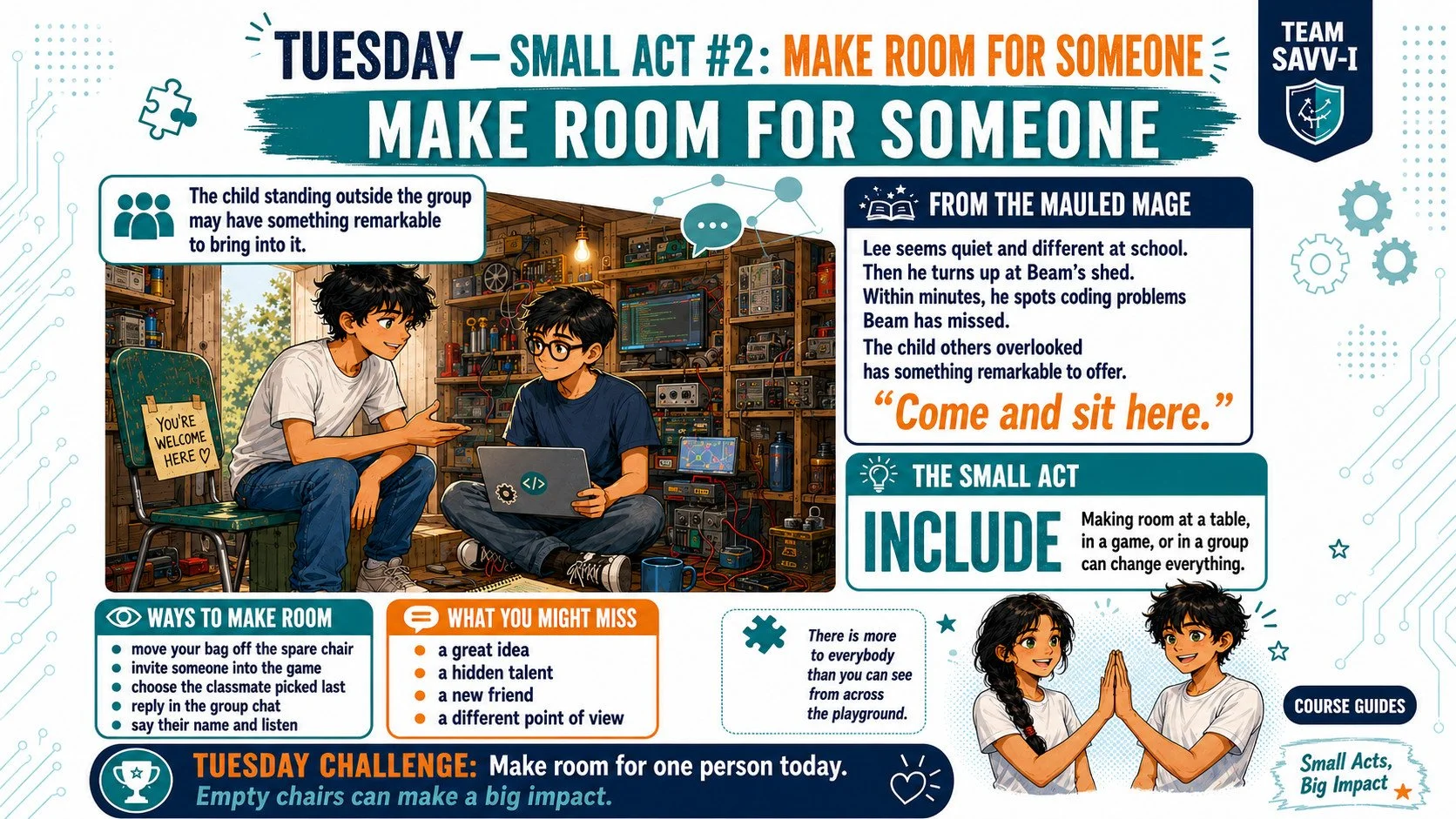
The child standing outside the group may have something remarkable to bring into it
Lee is not one of the cool kids in The Mauled Mage. He reads a lot. He keeps to himself. He behaves differently from Beam and his friends. Beam knows him, but he doesn’t really know him.
Then Lee turns up unexpectedly at Beam’s shed.
Within minutes, something changes.
Beam has been struggling for weeks with the computer code for his homemade portal. Lee looks at it and begins finding problems Beam has missed. The boy who seemed awkward at school turns out to be an extraordinary coder.
The Read-Aloud Kit describes Chapter 5: Fixing Code as a scene that “immediately overturns assumptions about him.”
That makes it a particularly useful Tuesday story for Small Acts, Big Impact.
Because one of the simplest ways to reduce the social soil in which bullying grows is to make room.
At a lunch table.
In a game.
Inside a group project.
Walking between classrooms.
In an online group.
It doesn't require a friendship ceremony. Nobody needs to announce that today they have become an Upstander With A Capital U.
Sometimes somebody simply says:
“Come and sit here.”
Children understand exclusion very quickly because school life is filled with tiny social thresholds. Who gets picked. Who receives the invitation. Who is already part of the group chat. Who walks into the playground and has somewhere obvious to go.
That is why I like using Lee.
Students can examine him from a distance.
Why might other children have dismissed him?
What assumptions did Beam make?
What changed when the two actually spent time together?
And, perhaps more interestingly, what would the group have missed if nobody had made room for Lee?
The Mauled Mage Activity Guide develops this idea further in its chapter on inclusion. One activity, The Puzzle Piece Challenge, treats each learner rather like a piece of a larger picture: the group cannot be complete by pretending every piece is identical. Another suggested extension lets students create pieces representing their own strengths and assemble them into a class community puzzle.
I would take the idea one step further during Bullying No Way Week.
Give every student a blank puzzle piece and ask them to put something on it that other children might not know about them.
Not necessarily their greatest talent.
Maybe:
I know a lot about insects.
I can fix bikes.
I speak another language with my grandparents.
I’m good at calming dogs.
I draw strange imaginary creatures.
I remember practically every dinosaur that ever existed.
Then assemble the pieces.
The resulting wall says something more interesting than Everyone is special.
It says:
There is more to everybody here than you can see from across the playground.
Bullying No Way’s own school materials connect belonging with challenging assumptions, empathy and recognising that differences contribute to a school community. (Bullying No Way)
For a nine-, ten- or eleven-year-old, however, I would keep Tuesday much more concrete.
Don't ask children to “create an inclusive culture”.
Ask: Who can you make room for today?
Move your backpack off the spare chair.
Ask somebody to join the game.
Choose the classmate who normally gets chosen last.
Reply when someone contributes to the group chat instead of leaving their comment hanging there.
Say their name.
Listen to their idea.
Lee eventually becomes central to The Mauled Mage. Yet his route into the group begins with two boys standing beside a computer and discovering that they have something in common.
Large policies matter.
So do empty chairs.
Tuesday’s small act: INCLUDE.
#BullyingNoWay #SmallActsBigImpact #InclusionMatters #TheMauledMage #BelongingAtSchool #MiddleGrade #CyberbullyingPrevention #Edufiction #StudentVoice #ThoughtBytes #BullyingNoWayWeek #SmallActsBigImpact #BullyingNoWay #LetsStopBullying #NationalDayOfAction #NDA2026