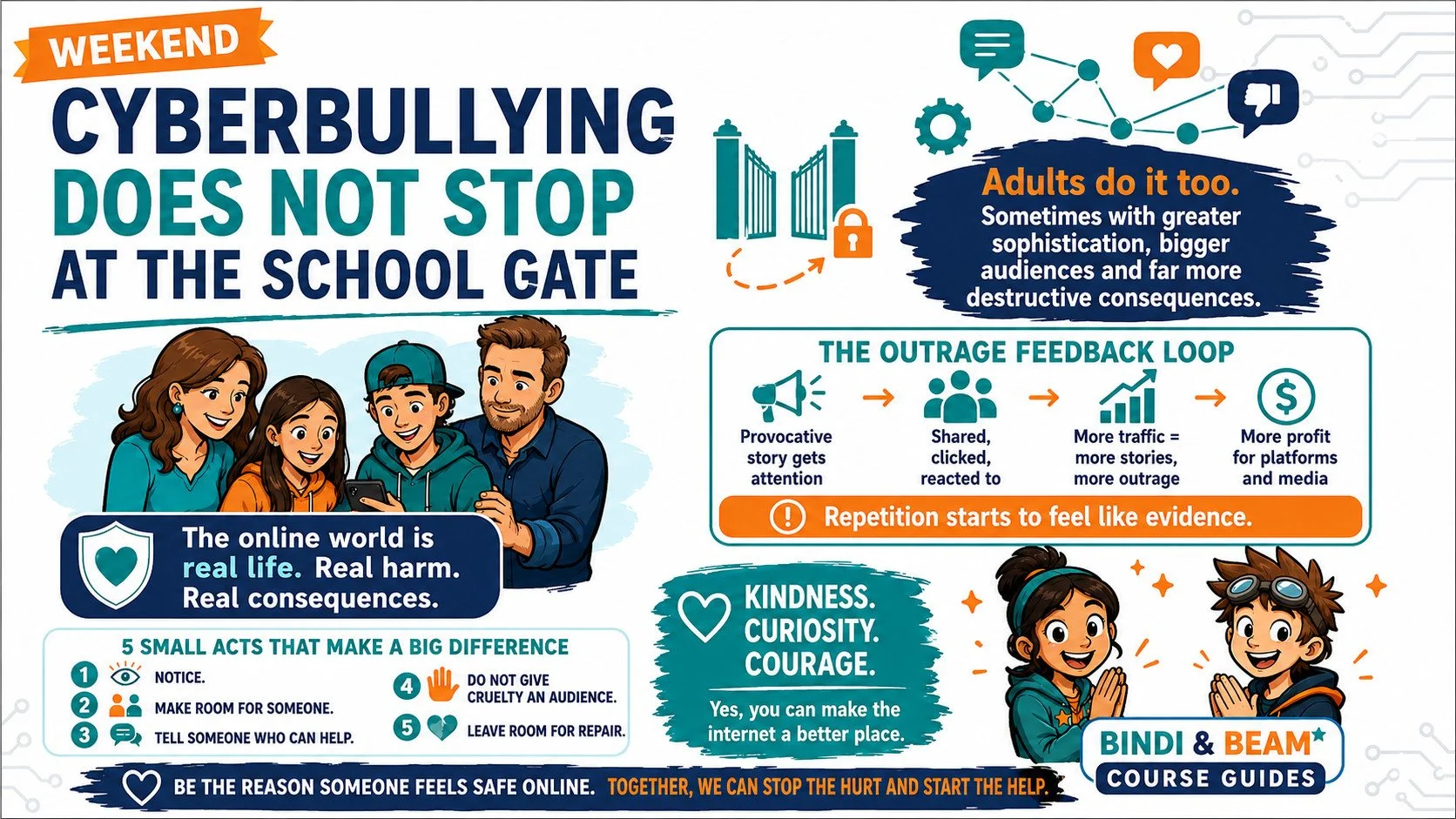
For the past five days, during Australia’s National Week of Action against bullying, I have written about small acts that can make an enormous difference in the lives of young people.
Notice.
Make room for someone.
Tell someone who can help.
Do not give cruelty an audience.
Leave room for repair.
There is a reason I want to finish this series by looking beyond the school gate.
We often speak about cyberbullying as though it is something children and teenagers do because they have not yet developed the maturity to understand the consequences of their behaviour.
I wish that were true.
Adults do it too.
Sometimes with considerably greater sophistication, much larger audiences and vastly more destructive consequences.
The Pulitzer-nominated investigative journalist Carole Cadwalladr recently described something particularly disturbing: an information system in which online outrage, social media algorithms, advertising economics and mainstream media coverage can begin feeding one another. Her argument is important because it moves the conversation beyond individual trolls or nasty comments.
The problem is not simply that people behave badly online.
We have built an information economy in which bad behaviour can be profitable.
Cadwalladr describes what amounts to a recursive feedback loop. A provocative story attracts attention. It is promoted because it attracts attention. More people click, comment, share and react. That traffic is interpreted as evidence of public interest. More stories follow. Social media discussion produces further material for journalists and commentators. Those stories generate another wave of posts, reactions and arguments.
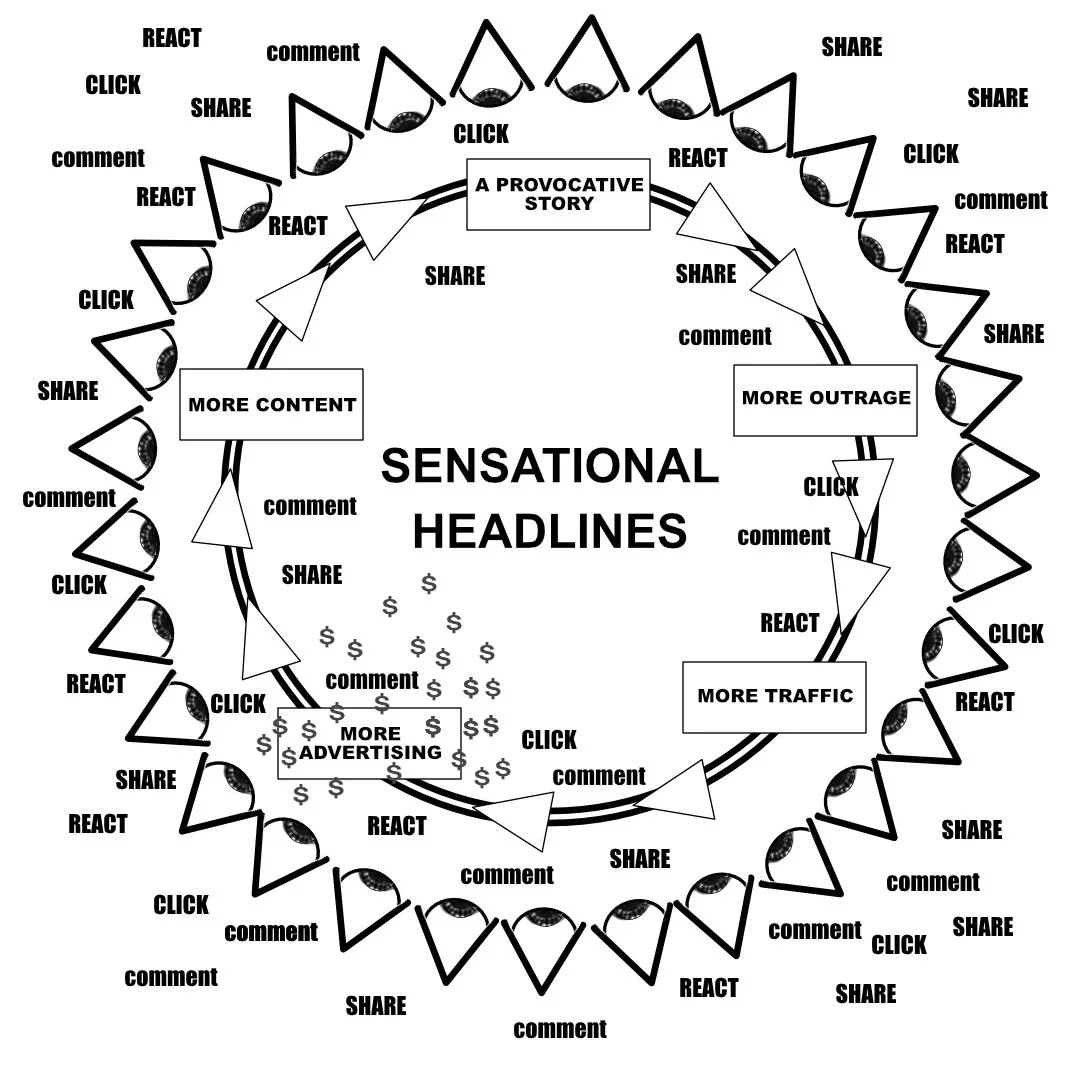
The Attention Trap Business Model
What began as an allegation, dispute or fragment of information can eventually become something much larger than the original event. And something important happens along the way. Repetition starts to feel like evidence.
When the crowd becomes the punishment
Imagine being the person at the centre of such a storm.
You wake to hundreds of messages.
People you have never met announce what sort of person you are.
Someone forwards an accusation.
Someone else adds a laughing emoji.
Another person posts a sarcastic comment.
Someone screenshots the comment and shares it somewhere else.
A commentator discusses it.
An article appears.
Someone links to the article as proof that the original accusation must have been correct.
Friends become hesitant about defending you because they do not want the crowd turning towards them.
Colleagues stay silent.
An organisation distances itself from you while it protects its own reputation.
You try to respond, but every response generates another round of posts.
Eventually you stop responding.
Then perhaps you stop posting.
Perhaps you stop going out.
Perhaps you begin wondering which colleagues believe what they have read.
You may even begin questioning your own perception of events.
Cadwalladr describes the profound helplessness that can accompany being trapped inside a public narrative that gains credibility simply through repetition. She also makes an important observation that parents and educators should understand: separating the “online world” from “real life” no longer makes much sense.
Digital humiliation produces real humiliation.
Digital isolation produces real loneliness.
Digital threats produce real fear.
Digital attacks can affect employment, friendships, family relationships, reputation and mental health. In extreme circumstances, prolonged networked harassment can be associated with devastating psychological distress, including depression and suicidality.
The screen does not make the harm imaginary.
The uncomfortable business model behind outrage
This is where the problem becomes more difficult.
A bully in a playground can be stopped by a teacher.
What happens when thousands of people participate?
And what happens when the platforms hosting the behaviour make money from keeping those thousands of people looking at the screen?
The commercial problem is obvious.
A calm correction may receive ten reactions.
An outrageous accusation might receive ten thousand.
An explanation may take six minutes to read.
A humiliating meme takes six seconds to share.
Algorithms designed to maximise engagement do not necessarily understand the difference between healthy discussion and collective cruelty. From the perspective of an engagement system, anger can look remarkably successful.
Cadwalladr argues that these dynamics can connect with mainstream publishing as well. Material that generates strong traffic is amplified, and that increased traffic can itself be interpreted as justification for producing more of the same material.
This creates a structural incentive problem.
We should therefore be cautious about imagining that Big Tech will solve online cruelty simply because online cruelty is socially undesirable. Platforms have strong reasons to remove clearly illegal material, respond to regulatory pressure and protect their reputations. But material that is merely humiliating, insinuating, polarising or vicious can still generate extraordinary engagement.
That means our children are entering a digital environment where the most responsible behaviour and the most profitable behaviour are not always the same thing.
That is one reason digital citizenship education matters so much.
Why Cyber Whispers matters
This is also why I wrote Cyber Whispers (soon to be published with associated learning resources).
For young teenagers, misinformation can initially seem like an abstract topic.
True or false.
Reliable source or unreliable source.
Fact-checking.
Fake news.
But information literacy is also about understanding what happens after we touch information.
Did I forward it?
Did I repeat it?
Did I react to it?
Did I add a laughing emoji?
Did I make the cruel comment more visible?
Did I assume that because fifty people were saying something, fifty people must independently know it to be true?
Or were forty-nine of them simply repeating the first person?
That distinction matters enormously.
Cyber Whispers uses story to let young readers explore these consequences through characters rather than having to begin with their own uncomfortable experiences. A rumour can travel. A fragment can become a story. A story can become a reputation. And once people begin reacting to the reputation rather than investigating the evidence, considerable harm can follow.
The lesson I want young people to understand is simple:
You do not have to write the original cruel post to become part of the machinery that spreads it.
Forwarding is participation.
Sharing is participation.
Adding a mocking comment is participation.
Sometimes even adding a laughing or smiling reaction can tell both the algorithm and the crowd: More of this.
That tiny action can feel insignificant to the person making it.
It may feel anything but insignificant to the person receiving hundreds of them.
The same five small acts still work
After a week discussing cyberbullying among young people, perhaps the most sobering conclusion is that adults need exactly the same lessons.
1 - Notice.
Look beyond the entertainment value of an online pile-on. There is a human being at the centre of it.
2 - Make room for someone.
When somebody is being socially isolated, a private message, conversation or gesture of normal human friendship can matter enormously. Cadwalladr particularly emphasises the value of private and public messages of support.
3 - Say something to someone who can help.
For children this may mean a parent, teacher or counsellor.
For adults it may mean an employer, professional organisation, platform moderator, union, regulator, lawyer or mental health professional.
Institutions also need to understand that remaining silent while hoping an online storm disappears may leave the targeted individual carrying the entire burden alone. Cadwalladr argues that organisations need better systems for responding to networked harassment, including active advocacy and practical support for people under attack.
4 - Do not give cruelty an audience.
Do not forward the humiliating post.
Do not pile on.
Do not add the clever joke.
Do not reward cruelty with another reaction simply because everyone else appears to be doing it.
And before sharing an accusation, ask the question we should be teaching every young person to ask: How do I know this is true?
5 - Leave room for repair.
This one becomes more complicated when harassment is organised, malicious or persistent. Accountability still matters.
But children also need to grow up understanding that human beings make mistakes. We should not build a culture in which every foolish comment, badly expressed opinion or past mistake becomes permanent evidence that a person deserves lifelong humiliation.
Education should produce better people, not merely better prosecutors.
Perhaps the adults need the lesson too
There is something deeply inconsistent about adults telling children to behave respectfully online while entire adult media ecosystems reward mockery, humiliation, tribalism and public destruction.
Young people notice that contradiction.
They see adults sharing rumours.
They see politicians insulting one another.
They see influencers directing followers towards individuals.
They see newspapers turning personal controversies into entertainment.
They see thousands of strangers celebrating the humiliation of someone they have never met.
Then we tell them: Be kind online.
Kindness matters, but it needs intellectual muscle behind it. That means teaching children how algorithms amplify behaviour, how repetition changes perceptions, how rumours mutate, how group psychology affects judgement and how their own seemingly tiny interactions contribute to the information environment around them.
That is the deeper purpose behind story-based resources such as Cyber Whispers.
I do not want young people simply to know that cyberbullying is wrong.
I want them to recognise the machinery that makes it grow.
Because one day they will not be twelve.
They will be journalists, teachers, employers, politicians, programmers, platform designers, parents and citizens.
And perhaps the most important lesson from National Cyberbullying Week is this:
The small acts we ask of children are exactly the small acts our adult digital culture desperately needs.
Notice.
Include.
Speak up.
Do not amplify cruelty.
Help people repair what can be repaired.
Because the crowd is made from individuals.
And so is the solution.
Reference: A Digital Lynching by Carole Cawalladr (August 18, 2026) https://broligarchy.substack.com/p/a-digital-lynching?r=8xjeku&utm_campaign=post&utm_medium=web