What my experience as a writer and educator has taught me about preparing children for an AI-enabled world
ThoughtBytes by Casper Pieters
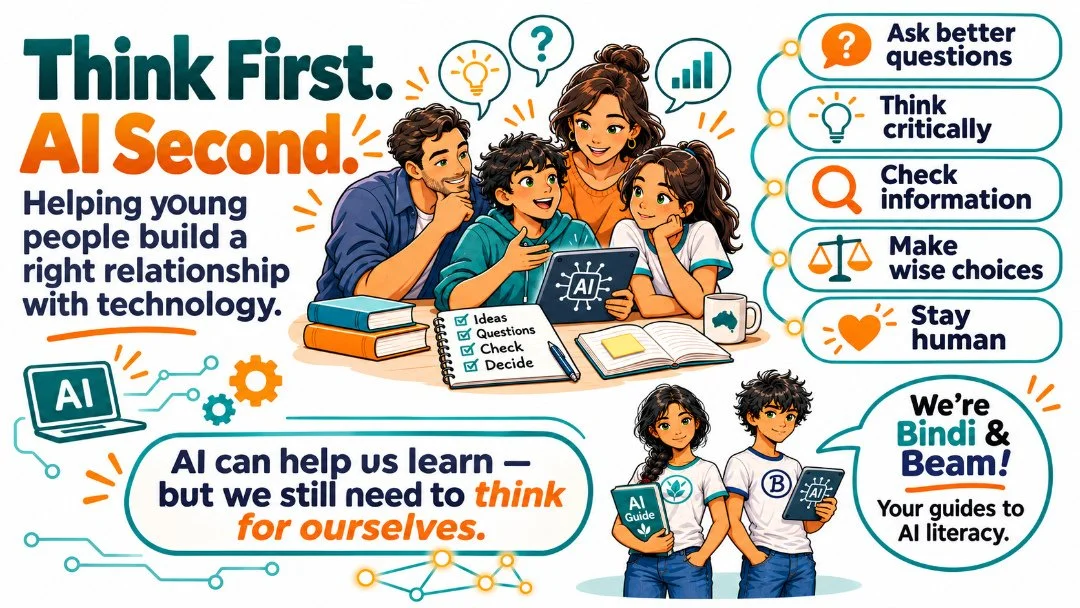
I believe one of the most important things we can do for young people today is help them establish a right relationship with technology, including artificial intelligence. By that I mean a relationship in which children retain the ability to think for themselves, make their own decisions and recognise when technology is influencing their behaviour. I want them to discover what technology can contribute to their lives without becoming so dependent on it that they lose confidence in their own abilities. I don't think we fully appreciate how important this is going to be.
The children we're educating today will enter a workforce that is already being reshaped by AI. Some of the jobs they'll apply for may not yet exist. Others will require considerably different skills from those we associate with them today. The other day, I read an article by Adam Mendler, How AI Is Changing How Colleges Prepare the Future Workforce (12 November 2026), in which a number of American higher education leaders discussed how they're responding to this situation. What interested me was how frequently the discussion returned to the importance of independent thinking. Teaching students to use AI effectively is becoming part of preparing them for employment, but employers will also need people who can question the output of AI, recognise its shortcomings and contribute something of their own.
On the same day, Séamus Boland, President of the European Economic and Social Committee, met with European Council President António Costa in Dublin. Boland emphasised the importance of giving younger generations strong AI literacy and critical-thinking skills. He also made a point about AI that I wholeheartedly agree with: “Europe’s (and everyone’s) success in AI will not be judged simply by what we can develop. It will depend on whether people trust the technology and whether its benefits are shared across society.”
There is something about this discussion that bugs me, though. Much of it concerns young adults preparing to enter the workforce. I think we need to start considerably earlier. By the time a young person arrives at university, they may already have spent ten years or more interacting with technology that recommends what they should watch, directs their attention and increasingly offers to do their thinking for them. Their habits, including their intellectual habits, will have been developing throughout those years. Waiting until they're eighteen to teach them how to exercise independent judgement when using AI seems rather late to me.
What I've discovered through writing with AI
I've spent much of my working life trying to make complicated subjects understandable. First as an ecologist, then through twenty years in science television, followed by educational technology and ten years of teaching. These days I write adventure stories for young readers and develop educational resources to accompany them. Curiosity has always driven much of what I do. And nowadays AI is very much part of that process. I use AI extensively in my writing, something I'm quite open about. I recently published a piece entitled How I Use AI, partly because I wanted to explain my relationship with the technology and partly because I think there is a considerable educational lesson in the way I've learned to work with it.
My creativity is not for outsourcing. My intuition leads me towards a subject that interests me. I explore it, usually because there's something about it I don't understand or something I find troubling. Sometimes I discover a connection between apparently unrelated subjects that intrigues me sufficiently to spend several months writing a novel about it. My background in ecology probably has something to do with this. Once you've spent years studying natural systems, you tend to see relationships and feedback loops everywhere. When I look at the way a social media algorithm learns from a child's behaviour and adapts the content it presents to that child, I find myself thinking about feedback loops in biological systems. There are interesting parallels, although they don't always hold up under scrutiny.
AI is a rather interesting companion to have around when I'm exploring such ideas. I can ask it to help me investigate the neuroscience of attention, explore an unfamiliar argument about consciousness or examine the psychology behind a character's behaviour. I sometimes ask it to argue against something I believe quite strongly. Occasionally, it makes a convincing case, and I find myself having to reconsider my position. That is an enjoyable part of working with AI. I don't particularly want a machine that agrees with everything I say.
I've also encountered perfectly plausible explanations that collapse as soon as I investigate the evidence. AI has supplied me with references that don't exist, made connections that initially sounded convincing but turned out to be quite misleading, and occasionally produced several paragraphs of beautifully polished nonsense. And yes, it sometimes helps me find the words for something I'm trying to express. I might have written a passage in which the dialogue doesn't ring true, or a scene in which I'm not quite getting across what a character is experiencing. I'll explore alternatives. Sometimes AI comes up with a sentence I wish I'd thought of myself. Other times, I discover that my original sentence was perfectly adequate. The decision remains mine.
What I've gradually come to appreciate is that working with AI in this way requires me to exercise many of the skills I want young people to develop. I need to bring some knowledge to the conversation. I need to recognise when an explanation doesn't make sense, follow up on interesting suggestions and occasionally admit that I've got something wrong. If I stopped doing those things, AI would probably make me a more prolific writer. I'm rather doubtful it would make me a better one.
A teacher's perspective on all this
Having spent ten years teaching, I'm particularly interested in what happens when we introduce AI into the learning process. There is a considerable difference between a student who has worked through a difficult problem and one who has simply obtained the correct answer. As teachers, we've always known this. Sometimes the two students hand in identical answers, and it's only when you sit down and have a conversation with them that you discover how differently they arrived there.
AI makes this old educational problem considerably more interesting. A young person can now produce a beautifully written essay about a book they haven't read. They can submit an explanation of a scientific concept they barely understand. They can even produce a persuasive argument about a subject on which they've never bothered to form an opinion. The work may be excellent. But what has the student actually learned?
I keep coming back to this question because it has implications for much of what we do in education. If an assignment can be completed by AI in a matter of seconds, perhaps we need to reconsider what we were asking the student to do in the first place. And this is where my experience as an author working with AI began to influence my work as an educator.
I realised that the way I work with AI could provide the basis for an educational approach. I bring my curiosity, knowledge and ideas to a subject. I begin developing my own understanding before bringing AI into the conversation. Then I investigate further, sometimes revise my thinking and make a decision about what I believe is worth pursuing. I don't see any reason why young people can't gradually learn to work in a similar way.
That realisation became the basis for my Think First. AI Second. learning resources and the Task Design approach I use to develop them.
What does this look like in practice?
I have a particular advantage as an author of edufiction. My characters are continually getting themselves into situations that provide rather useful starting points for learning about technology.
Take Beam, one of the young teenagers in my books. In Brain Rot!, Beam becomes increasingly caught up in the persuasive design of a digital platform called Zipp. His attention becomes fragmented, his judgement suffers, and he begins losing control over aspects of his everyday life. I wanted young readers to experience what was happening to Beam through the story, because many of them will recognise something of their own experience in his.
In one of my Think First. AI Second. learning resources, Brain Rot! Beam's Bad Day: The AI Investigator Challenge, young people begin by watching a short, six-and-a-half-minute video. They then investigate what happened to Beam. Before AI enters the picture, students examine the story for evidence.
What was Beam doing?
What kept drawing him back to the screen?
How did his behaviour affect the people around him?
They can record their observations on paper, discuss them with others and start developing their own explanations. I like this part of the activity. Different children will notice different things. One might be interested in how Zipp keeps Beam engaged. Another might be much more concerned about how Beam treats his friends. Both observations have considerable educational value, and I wouldn't want to lose either of them by supplying a ready-made interpretation of the story.
Once the students have developed some ideas of their own, AI becomes available as an additional resource. They can ask it to investigate persuasive technology, explore why certain design features are so effective or examine an explanation they've come up with. They can compare what AI tells them with the evidence they've collected from the story. If the machine makes an unsupported claim, they have something against which to assess it.
Later, they can attempt to redesign aspects of Zipp so that it becomes a platform people can enjoy without being continually manipulated into spending more time on it. That's an interesting design problem. How would you make a digital platform sufficiently appealing that young people want to use it without deliberately exploiting their psychological vulnerabilities? Even the people who develop these platforms don't always seem to have given that question the attention it deserves. It is exciting to see what a group of twelve-year-olds comes up with!
The young learners can use AI to investigate alternative designs, identify weaknesses in their proposals or explore how a particular feature might work. But they will have to make their own decisions about the sort of technology they want to create and explain why they think their design is an improvement. Notice what's happening here. The students are learning about the technology while practising the kind of thinking they'll need to use it responsibly. They also have to consider what their decisions might mean for another human being.
That last part is particularly important to me. Digital and AI literacy have always been closely associated with character education in my stories. I want young people to develop an appreciation of how their choices affect others, including choices they make when designing or using technology.
We need to rethink what we reward in education
One of the more interesting points raised in Adam Mendler's article is that colleges are reconsidering how students demonstrate what they've learned. I think schools need to do the same. When I develop a learning resource now, I'm interested in what the student brings to the task before using AI, what happens to their thinking during the investigation and what they understand afterwards.
Did they discover that an initial assumption was incorrect?
Did AI help them see something they'd overlooked?
Did they reject a suggestion because it conflicted with the evidence?
Can they explain their final decision in their own words?
A student who changes their mind after discovering something new may have learned considerably more than a student who produces a flawless answer at the beginning of the lesson.Yet a beautifully presented piece of work can still attract a higher mark than a messy investigation in which a student has done some genuinely interesting thinking. We need to be careful about what we're rewarding.
‼️ This is why my Task Design resources include opportunities for students to document their thinking, discuss their ideas, investigate with AI where appropriate and explain the decisions they've made. It also means there are parts of the learning process in which AI is deliberately absent.
Children need opportunities to find out what they're capable of doing independently. Some of the intellectual effort involved may be uncomfortable. They may get stuck for a while. They may produce something that needs considerable improvement. There is educational value in that experience. I'd be rather concerned if we began treating every instance of a child struggling with a difficult idea as a problem that technology should immediately solve.
A little something parents can try at home
You don't need an elaborate lesson plan to help your child develop a right relationship with AI. Try investigating something together that neither of you fully understands. It could be a question that arises from a book you're reading, something your child has encountered online or a news story that doesn't quite make sense. Before consulting AI, spend a few minutes talking about what you already know and what you think might be happening. Your child might have an explanation you hadn't considered. Then ask AI to contribute to the discussion. I would deliberately include a question that challenges your initial understanding. See what the machine comes up with and investigate whether its explanation holds up. You might even discover that your child is more sceptical of AI's answer than you are.
The experience of a parent saying, “I'm not sure that's right. Let's find out,” is a valuable one for a child. It gives them permission to question a seemingly knowledgeable authority, something they'll need to feel comfortable doing throughout their lives. This is also one of the reasons I've developed my free AI-Ready Kids for Parents course. I want parents to discover how much they can contribute to their children's AI literacy through ordinary conversations and shared experiences at home. They don't need to become AI experts. What they do need is a willingness to engage with their children's curiosity.
Preparing children for a future we can't yet describe
I sometimes wonder what the young people reading my books today will be doing in twenty years.
Will they be working alongside intelligent systems that are capable of things we can barely imagine?
Will some of them be developing those systems themselves?
What kinds of decisions will they be expected to make about the lives of other people?
I can't answer those questions with any confidence. What I do know is that I'd like those young people to enter adulthood with an appetite for learning and the confidence to pursue an idea of their own. I'd like them to be able to disagree with a highly intelligent machine, including on occasions when the machine turns out to be right. I hope they'll have the courage to question how technology is being used and to consider whether what is technically possible is actually desirable.
My own experience of working with AI has made me more aware of the educational possibilities. I've discovered how much the technology can contribute to an inquisitive mind, provided that the person using it remains actively involved in the thinking. And that is what I want my Think First. AI Second. resources to help young people discover.
The other morning I was working on a story involving a young person who becomes rather dependent on an intelligent machine. As I explored the psychology of the character, it occurred to me that I was using AI to help me investigate the dangers of becoming too dependent on AI. There's something rather amusing about that. But it also reminded me of why I'm so interested in the relationship we develop with this technology. I was thoroughly enjoying the process of exploring the ideas, questioning the suggestions and discovering things I hadn't previously considered, but I wouldn't want to hand all of that over to a machine. It would deprive me of what I enjoy from writing process (yes, even at 4:30 in the morning!). I don't want our children to miss out on the pleasure of discovering what their own minds are capable of either.
Think First. AI Second.
Discover my story-led digital and AI literacy learning resources, including the free Brain Rot! Beam's Bad Day video and accompanying educational activities. It will give you a good taster of what story-led learning is all about.
Further reading
Adam Mendler (2026, November 12). How AI Is Changing How Colleges Prepare the Future Workforce. Read the article.
European Economic and Social Committee (2026, November 12). EESC President Boland brings civil society's AI message to President Costa ahead of EU leaders meeting. Read the article.
Casper Pieters. How I Use AI. My personal statement on creativity, authorship and working with artificial intelligence.