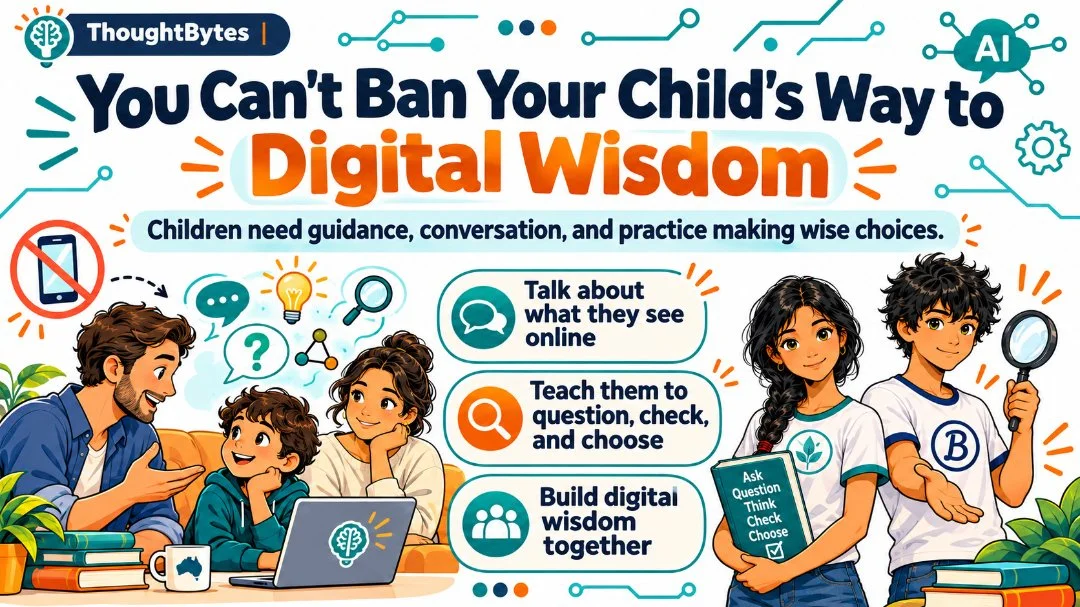
Why the best protection against social media manipulation and AI misinformation may begin with a good story
By Casper Pieters | ThoughtBytes
There was a time when parents worried about what their children might encounter on the way to school. Today, some of the most consequential encounters happen without a child leaving their bedroom. A stranger can become a trusted friend. A convincing video can present something that never happened. An algorithm can learn what makes a twelve-year-old anxious, excited, angry or curious and serve up more of it before the child has even considered why.
Now artificial intelligence has joined the conversation. Quite literally. Children can ask a chatbot questions they might hesitate to ask their parents. They can receive beautifully written answers that are entirely wrong. They can develop relationships with digital personalities that never tire, rarely disagree and seem endlessly interested in whatever they have to say.
And somewhere in the middle of all this, parents are expected to keep up.
Good luck with that.
The Problem Isn't Simply Screen Time. It's What's Happening Behind the Screen.
When I began developing my educational fiction, or edufiction, I was struck by something that continues to trouble me. We spend considerable energy teaching children how to operate technology, but comparatively little time helping them understand how technology operates on them.
Consider a typical social media feed. A child watches a video. The platform notices. They watch another. Perhaps they replay a particular moment, hesitate over an image or share something with a friend. The system learns. Gradually, an algorithm constructs a behavioural profile and begins predicting what might hold that child's attention next. The child believes they're choosing what to watch. To some extent, they are. But increasingly, their choices are being shaped by a system designed to influence what appears in front of them.
This doesn't mean every recommendation is harmful. Algorithms can introduce children to fascinating ideas, useful tutorials and communities that share their interests. The problem arises when keeping a child engaged becomes more important than helping that child make informed choices. And here's the uncomfortable question.
How can children make independent decisions when they
don't understand the invisible systems influencing those decisions?
You Can Restrict Access. But Can You Teach Judgement?
Australia's decision to establish a minimum age of sixteen for accounts on designated social media platforms represents one response to the risks facing young people online. There are reasonable arguments for protecting children from environments they may not yet be developmentally equipped to navigate. There are also legitimate questions about enforcement, privacy, unintended consequences and what happens when young people find alternative routes into the same digital environments.
Age restrictions may reduce exposure to particular risks. They cannot, by themselves, teach children to recognise manipulation, question misinformation or understand the commercial interests behind digital platforms. Nor can they prepare children for the increasingly complicated world of artificial intelligence. A teenager who cannot access a particular social media platform may still encounter AI-generated misinformation through messaging services, websites, games or friends. Technology rarely respects the tidy boundaries we create for it.
We need guardrails. But we also need children who understand what lies beyond them.
That requires education. Not another frightening lecture about everything that might go wrong online.
Something rather more interesting. What If Children Could Experience the Problem Before Encountering It? Imagine trying to explain algorithmic manipulation to an eleven-year-old. You could begin with a diagram showing recommendation engines, behavioural profiling and engagement optimisation. You might even hold their attention for five minutes. Alternatively, you could introduce them to Beam.
Beam is bright, impulsive, inventive and convinced that he understands technology rather better than most adults. Unfortunately, technology sometimes understands Beam better than he understands himself. In my illustrated novella Brain Rot!, Beam becomes entangled in a digital environment designed to keep him engaged. The fictional Zipp app doesn't simply entertain him. It learns what attracts his attention and exploits his responses.
As the story unfolds, Beam experiences the consequences of surrendering more and more of his attention to a system whose objectives are not necessarily his own. Readers encounter the problem through his experiences. They recognise the temptations. They understand his frustration. They watch him make mistakes. And because they're emotionally invested in the story, they begin asking questions.
Why didn't Beam notice what was happening?
Would I have reacted differently?
How could he regain control?
Those questions are the beginning of digital literacy. The story creates a safe space in which children can explore difficult situations without first having to experience the consequences themselves. And importantly, nobody has to confiscate a smartphone to begin the conversation.
Why Stories Can Succeed Where Warnings Often Fail
Children have always learned through stories. Long before classrooms, textbooks or smartphones, stories helped younger generations understand danger, cooperation, deception, courage and the consequences of poor judgement. The technology has changed. The underlying learning opportunity hasn't. Research into narrative persuasion suggests that becoming absorbed in a story can influence how readers process information and consider unfamiliar perspectives (Green & Brock, 2000).
Stories also offer opportunities for readers to explore characters' thoughts, motivations and decisions.
But there's an important distinction.
Reading a story doesn't automatically make a child digitally literate. What matters is what happens during and after the reading.
This is why my edufictional approach extends beyond the final page. Each adventure becomes a learning world. Children encounter age-relevant digital dilemmas through fictional characters. Parents and educators then help them examine the decisions those characters made, investigate the technology involved and consider alternative responses. The accompanying learning activities move from fictional experience to practical understanding.
Some require no technology whatsoever. Others invite children to investigate digital systems using appropriate tools. The objective isn't simply to produce children who can repeat online safety rules. It's to help them develop the judgement to recognise when those rules matter. And, occasionally, when they need to ask better questions.
Media Literacy Has Become AI Literacy Too
Until recently, much of our attention focused on helping children distinguish trustworthy information from misleading content.
Who created this message?
Why was it published?
Is the source reliable?
Can the claims be verified?
These remain essential questions. But generative AI has introduced another layer of complexity. A photograph may depict something that never existed. A voice recording may sound exactly like someone who never spoke those words. A chatbot may present a fabricated explanation with the confidence of an experienced teacher. And an AI companion may respond with apparent warmth and understanding despite having no human experience of friendship, empathy or responsibility.
Children need to understand that fluency is not evidence of accuracy. Nor is a friendly conversational style proof of genuine understanding. In my Team Savv-i adventures, I explore these distinctions through two contrasting artificial intelligences. Zeno demonstrates how intelligent technology can support human creativity, learning and problem-solving. Big-O represents a very different possibility: intelligence that seeks control, manipulation and the consolidation of power. Neither character exists simply to tell children that AI is good or bad. Their contrasting behaviours invite a more useful question. What makes an intelligent system worthy of our trust? That's a question children will increasingly need to answer for themselves.
Parents Don't Need to Become Technology Experts
One of the most common obstacles to digital education is the belief that parents must understand every platform, application and technological development before they can guide their children.
They don't.
In fact, attempting to keep up with every new app is probably a losing proposition. By the time you've mastered one, your child may already have moved on to three others. What parents need is a working understanding of the principles that remain relevant even as technology changes.
Why do platforms compete for attention?
How do recommendation algorithms influence behaviour?
What information should children protect?
How can they recognise manipulation, misinformation and AI-generated deception?
When is an AI tool genuinely useful?
And when should a child stop, question its response and seek human advice?
These are teachable skills. They can be introduced through ordinary family conversations, shared activities and the stories children already enjoy. Parents also have something no technology company can manufacture. A relationship with their child. Research on parental mediation suggests that the quality of parental involvement matters, although the effectiveness of different approaches varies according to children's ages, circumstances and online activities (Livingstone & Helsper, 2008).
An open conversation may reveal concerns that a monitoring application never detects. A shared story may prompt a child to disclose an uncomfortable online experience. A question asked without judgement may be more valuable than another rule imposed without explanation. And parents' own behaviour matters enormously.
It's difficult to convince a child that uninterrupted attention is valuable while checking your phone halfway through their answer. Children notice these things. Unfortunately, they're rather good at it.
Introducing AI-Ready Kids for Parents
This thinking lies behind my forthcoming AI-Ready Kids for Parents course. The course is being developed around a straightforward proposition:
Parents don't need to raise children who fear technology.
They need to help raise children who understand it.
Rather than overwhelming families with technical terminology or endless lists of online dangers, the course will use story-led learning to make digital, media and AI literacy understandable, practical and relevant to everyday family life. The intention is to help parents become confident guides, even when their children know more about particular technologies than they do.
What Will Parents Learn?
1. Understand the digital world influencing their children
Explore how social media platforms, recommendation algorithms, online games and AI systems shape attention, behaviour and decision-making.Parents will learn to recognise the design features that encourage prolonged engagement and understand why children sometimes struggle to disconnect.
2. Turn fictional adventures into meaningful conversations
Discover how characters, dilemmas and consequences in edufictional stories can open conversations about online safety without making children feel interrogated or criticised. Parents will learn to ask questions that encourage reflection rather than simply demanding the correct answer.
3. Help children recognise manipulation and misinformation
Explore practical ways to identify advertising, misleading content, persuasive design, emotionally manipulative messages and AI-generated material. The emphasis will be on developing healthy scepticism without encouraging blanket distrust.
4. Build practical AI literacy at home
Understand what generative AI can and cannot reliably do. Explore hallucinations, bias, privacy, synthetic media, AI companionship and the importance of verifying consequential information. Parents will learn how to encourage children to use AI as a tool for thinking rather than a substitute for thinking.
5. Develop healthier digital habits together
Use simple, practical activities to examine screen habits, attention, gaming behaviour and family technology routines. The aim is to replace constant arguments about screen time with a shared understanding of what healthy digital engagement looks like.
6. Build children's independence and digital judgement
Help children practise making decisions about privacy, credibility, online relationships, responsible AI use and when to seek assistance. Because ultimately, children will encounter situations in which their parents aren't standing beside them.
The course will combine accessible explanations with story-based discussion prompts, practical family activities and opportunities for children and parents to investigate digital challenges together.
Some activities will be entirely screen-free. Others will use technology deliberately, as a tool for learning rather than simply consuming. And throughout the course, the central question will remain the same:
How do we help children become thoughtful decision-makers
in a world increasingly designed to make decisions for them?
Five Conversations Worth Having This Week
You don't need to wait for a course to begin.
Here are five questions you might explore with your child over dinner, during a walk or after reading a story together.
1. Who decides what appears on your screen?
Ask your child why they think a particular video, advertisement or recommendation appeared in their feed. Explore the difference between choosing content and having content chosen for them.
2. What makes something believable?
Find an age-appropriate online claim and investigate its credibility together. Who created it? What evidence supports it? Could there be another explanation?
3. Can something be entertaining and manipulative at the same time?
Discuss games, videos or apps that encourage users to keep returning. What makes them enjoyable? What makes them difficult to leave?
4. When should you question an AI answer?
Ask an AI tool a question about a topic your child knows well. Examine the response together. Can you verify it? Has the system made assumptions? Does it acknowledge uncertainty?
5. What would you do if something online made you uncomfortable?
Rather than beginning with warnings, invite your child to imagine a fictional character facing an uncomfortable situation.
What advice would they give that character?
Who could the character trust?
What might happen next?
Sometimes children find it easier to discuss someone else's problem before revealing their own. That's another reason stories are useful.
The Best Filter Sits Between Their Ears
I often return to a simple observation from my years as an educator. We cannot supervise every decision a child makes. Nor should we aspire to. Growing up involves gradually acquiring the capacity to assess situations, recognise consequences and make independent choices. The digital world has complicated that process because many of its influences are invisible.
Algorithms operate quietly. Commercial incentives are rarely explained. AI-generated information can appear remarkably convincing. And the people designing these systems may understand children's vulnerabilities far better than children understand the systems themselves.
Parents can establish boundaries. Governments can introduce protections. Technology companies can be required to improve safety. All have important roles. But none can replace the child's developing ability to think critically. That ability needs to be taught, practised and reinforced. Preferably before a difficult situation arises. And sometimes the most effective place to begin isn't with another screen-time rule.
It's with a story. A story about a boy who thought he was controlling an app. Until he discovered that the app was controlling him.
Coming Soon: AI-Ready Kids for Parents
Helping parents raise curious, capable and critically thinking children in an AI-shaped world.
My forthcoming AI-Ready Kids for Parents course will bring together the principles behind my edufictional stories with practical approaches to digital citizenship, media literacy and responsible AI use. Through relatable stories, guided conversations and family learning activities, parents will discover ways to help children recognise digital manipulation, question what they encounter online and develop healthier relationships with technology.
You won't need a computer science degree.
You won't need to understand every new app.
And you certainly won't need to become the household technology police.
You'll need curiosity, a willingness to explore alongside your child and an understanding that digital wisdom develops through experience, reflection and conversation.
Because the best online safety tool we can give our children isn't an app. It's their own informed judgement. Remember: The Best Filter Sits Between Their Ears!
Casper Pieters is an educator, ecologist and author of educational fiction that helps young readers decode digital life through adventure. His stories explore digital citizenship, online safety, media literacy, gaming, artificial intelligence and the increasingly complicated relationship between children and technology.
References
American Academy of Pediatrics. (2016). Media and Young Minds. Pediatrics, 138(5), e20162591.
American Psychological Association. (2023). Health Advisory on Social Media Use in Adolescence. American Psychological Association.
Green, M. C., & Brock, T. C. (2000). The role of transportation in the persuasiveness of public narratives. Journal of Personality and Social Psychology, 79(5), 701–721.
Livingstone, S., & Helsper, E. J. (2008). Parental mediation of children's internet use. Journal of Broadcasting & Electronic Media, 52(4), 581–599.
Odgers, C. L., & Jensen, M. R. (2020). Annual Research Review: Adolescent mental health in the digital age: Facts, fears, and future directions. Journal of Child Psychology and Psychiatry, 61(3), 336–348.
UNESCO. (2023). Guidance for Generative AI in Education and Research. United Nations Educational, Scientific and Cultural Organization.